
Coordinates Q7: Points on Segments and Coordinate Relationships
Loading the math board and drawing, please wait…
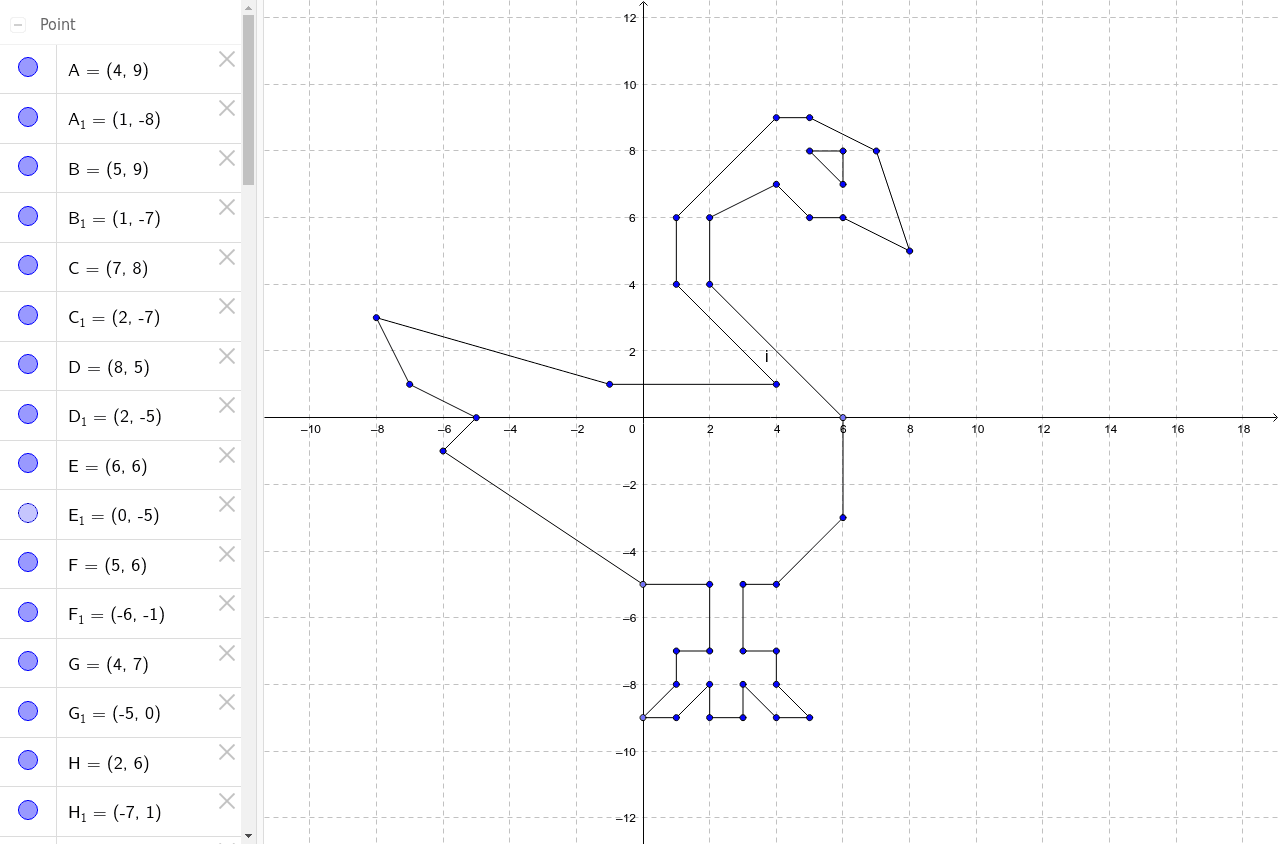
① This example demonstrates how to practice determining coordinates of points and understanding the relationship between coordinates and geometric positions in a Cartesian plane, using segments and points. ② Core mathematical concepts include coordinate geometry, point coordinates, points on segments, and basic applications of angles and equations. ③ Construction highlights: Based on the construction summary, the GeoGebra commands Segment and Point are used, creating multiple points (A, B, C, etc.) and segments (a, b, etc.), allowing interactive exploration of coordinate changes. ④ Suitable for middle or high school students learning introductory analytic geometry, useful for classroom exercises or self-study, and can serve as a template for teachers to create coordinate practice problems.
GeoGebra Commands & Parameters
Segment(A, B) → aSegment(C, B) → bSegment(C, D) → cSegment(D, E) → dSegment(E, F) → eSegment(F, G) → fSegment(G, H) → gSegment(H, I) → hPoint(xAxis) → JSegment(I, J) → iSegment(J, K) → jSegment(K, L) → kSegment(L, M) → lSegment(M, N) → mSegment(N, O) → nSegment(O, P) → pSegment(P, Q) → qSegment(Q, R) → rSegment(R, S) → sSegment(S, T) → tSegment(T, U) → a_1Segment(U, V) → b_1Segment(V, W) → c_1Point(yAxis) → ZSegment(W, Z) → d_1Segment(Z, A_1) → e_1Segment(A_1, B_1) → f_1Segment(B_1, C_1) → g_1Segment(C_1, D_1) → h_1Point(yAxis) → E_1Segment(D_1, E_1) → i_1Segment(E_1, F_1) → j_1Segment(F_1, G_1) → k_1Segment(G_1, H_1) → l_1Segment(H_1, I_1) → m_1Segment(I_1, J_1) → n_1Segment(J_1, K_1) → p_1Segment(K_1, L_1) → q_1Segment(L_1, M_1) → r_1Segment(M_1, A) → s_1Segment(N_1, O_1) → t_1Segment(O_1, P_1) → a_2Segment(N_1, P_1) → b_2