
Exploring Parallelograms: Definitions and Properties
Loading the math board and drawing, please wait…
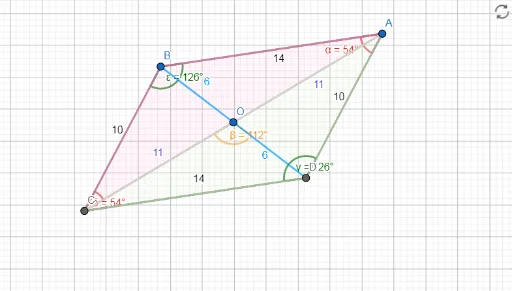
This example demonstrates the definition and properties of parallelograms through a dynamic application. It involves core mathematical concepts such as parallelograms, angles, sides, and diagonals. The construction utilizes GeoGebra commands like Circle, Segment, Angle, Polygon, and objects including points (O, A, C, B, D), segments (c, d), angles (β, α, γ, δ, ε), and sliders (t1, t2). It is suitable for middle school and above, aiding students in visually understanding geometric properties and related theorems.
GeoGebra Commands & Parameters
Circle(O, A) → cCircle(O, B) → dSegment(B, A) → fSegment(A, D) → gSegment(D, C) → hSegment(B, C) → iSegment(O, A) → jSegment(O, C) → kSegment(O, B) → lSegment(O, D) → mAngle(C, O, D) → βAngle(B, A, D) → αAngle(A, D, C) → γAngle(D, C, B) → δAngle(C, B, A) → εPolygon(A, B, C) → t1, c_1, a, bPolygon(C, D, A) → t2, a_1, c_2, d_1