
Exploring Parallelogram Characteristics
Loading the math board and drawing, please wait…
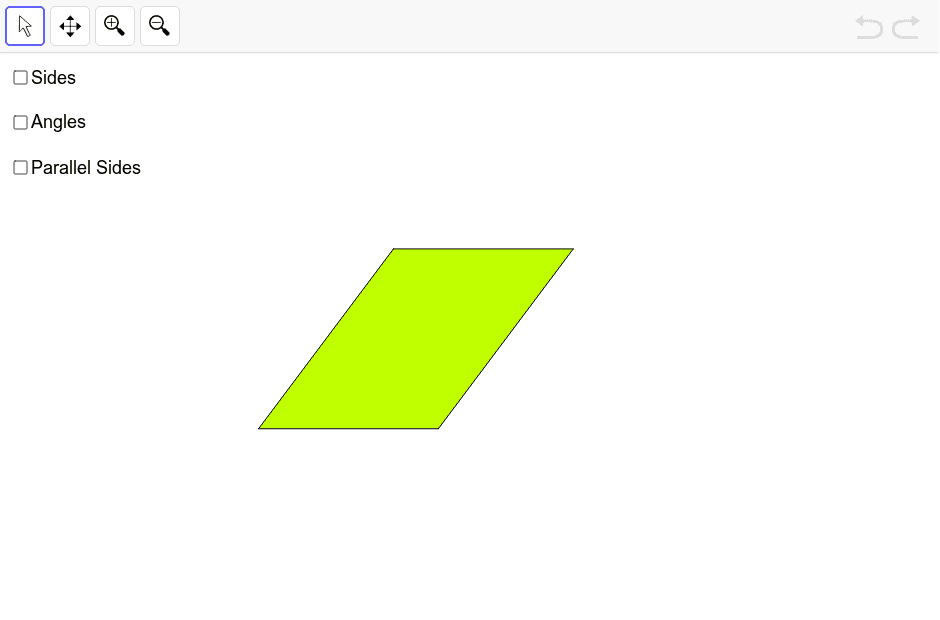
This example demonstrates the geometric characteristics of parallelograms. Key math concepts include parallel lines, diagonals, interior angles, and vectors. Construction involves GeoGebra commands such as Midpoint, Point, UnitOrthogonalVector, UnitVector, Polygon, Angle, and Rotate. Suitable for middle school and above students to learn and understand parallelogram properties, ideal for geometric visualization in education.
GeoGebra Commands & Parameters
Midpoint(A, C) → OPoint(Circle[A_1, ruler]) → A_6UnitOrthogonalVector(Segment[A_1, A_6]) → vUnitVector(Segment[A_1, A_6]) → uPolygon(A_1, A_2, A_3, A_4, A_5, A_6) → poly6, a_3, a_4, a_5, a_6, a_7, a_8Polygon(A, B, C, D) → poly1, a, b, c, dAngle(D, A, B) → αAngle(A, B, C) → βAngle(B, C, D) → γAngle(C, D, A) → δRotate(Translate[C, Vector[O, O']], θ, O') → C'Rotate(Translate[B, Vector[O, O']], θ, O') → B'Rotate(Translate[D, Vector[O, O']], θ, O') → D'Rotate(Translate[A, Vector[O, O']], θ, O') → A'Polygon(O', A', B', C', D', A') → poly2, o', a', b', c', d', a'_1Polygon(A', B', C', D') → poly3, a'_2, b'_1, c'_1, d'_1Angle(B', A', D') → α'Angle(A', B', C') → β'Angle(B', C', D') → γ'Angle(C', D', A') → δ'Angle(D, A, B) → α_1Angle(B', A', D') → α'_1Angle(A, B, C) → β_1Angle(A', B', C') → β'_1Angle(B', C', D') → γ'_1Angle(B, C, D) → γ_1Angle(C, D, A) → δ_1Angle(C', D', A') → δ'_1
AI Drawing Prompt Reference
Draw a parallelogram, marking its diagonals, midpoints, parallel lines, and the lengths of its sides and interior angles. Represent the directions of the parallel lines with vectors and demonstrate that the midpoints of the diagonals coincide. Rotate half of the parallelogram and observe the relationships between the angles and side lengths before and after rotation, highlighting the properties of diagonals bisecting each other and interior angles being supplementary.
The prompt above was compiled from the original drawing commands and is for reference only.