
Exploring Composite of Three Reflections Across Parallel Lines
Loading the math board and drawing, please wait…
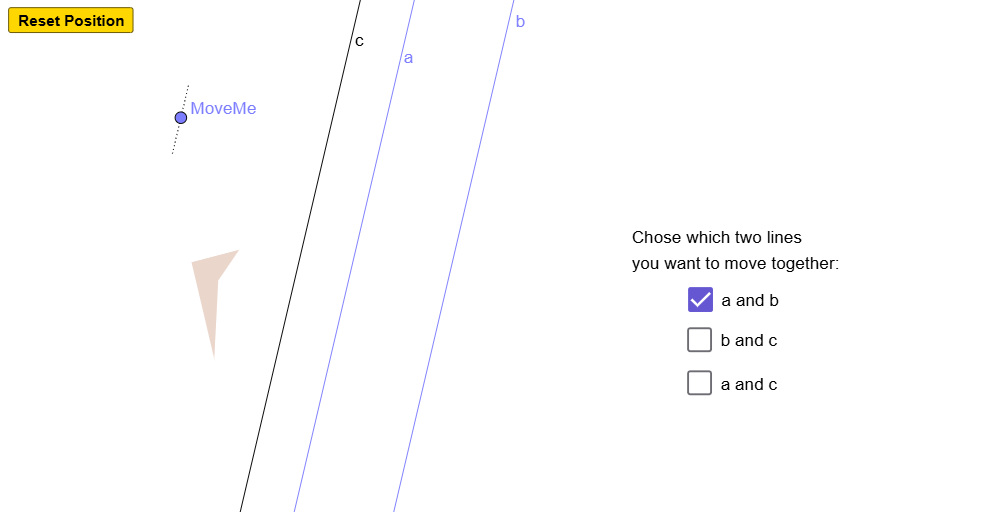
① This example demonstrates the composite effect of reflecting a figure successively across three parallel lines, revealing how multiple reflections combine into a single transformation. ② The core mathematical concepts are reflection transformations and their composition: two reflections across parallel lines yield a translation, while three reflections across parallel lines yield a reflection (or a glide reflection), involving symmetry, translation, and vector operations. ③ Construction details: Based on the summary, the GeoGebra commands used include Line, Point, Segment, OrthogonalLine, Vector, Translate, and Polygon. Objects such as points (A, B, C, D, E, F, I, J, K), lines (a, b, c, f, g), segments, vector v, and polygon poly1 are defined. The step and Reset buttons control animation stages, and MoveMe provides interactive dragging to explore the transformation dynamically. ④ This is suitable for high school or early college students learning geometric transformations, and for teachers demonstrating the algebraic and geometric properties of reflection composition, enhancing spatial reasoning and logical thinking.
GeoGebra Commands & Parameters
Line(A, B) → a_{1}Line(C, a_{1}) → b_{1}Line(D, b_{1}) → c_1Line(E, a_{1}) → ePoint(e) → GPoint(e) → HSegment(G, H) → fOrthogonalLine(E, f) → gPoint(g) → MoveMeVector(E, MoveMe) → vTranslate(a_{1}, v) → aTranslate(b_{1}, v) → bPolygon(F, I, J, K) → poly1, f_1, i, j, kTranslate(c_1, v) → c
AI Drawing Prompt Reference
Draw a figure with five parallel lines a, b, c and two auxiliary lines e, g. First, draw a line a with points A and B as endpoints. Then, draw line b with points C and a's point, and draw line c with points D and b's point. Next, draw line e with points E and a's point, and take points G and H on line e, then draw line segment f between G and H. Draw line g with points E and f's point. Take point MoveMe on line g, draw vector v from point E to MoveMe, then translate line a by vector v to get line a', translate line b by vector v to get line b', and finally translate line c by vector v to get line c'. The figure includes points F, I, J, K and polygon poly1.
The prompt above was compiled from the original drawing commands and is for reference only.