
Exploring Areas of Parallelograms
Loading the math board and drawing, please wait…
In collections
Area of Triangles and Quadrilaterals
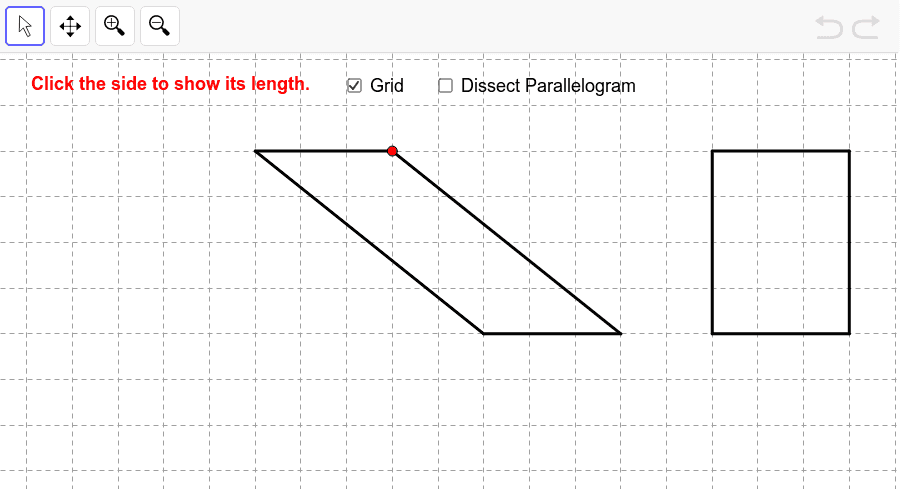
This example demonstrates how to explore the area of parallelograms of different shapes, including skewed ones. It involves core math concepts like the area formula for parallelograms, vectors, and triangle areas. Construction uses GeoGebra commands such as Point, Ray, Translate, Rotate, Vector, and Midpoint. Suitable for middle school students and math enthusiasts learning geometric properties.
GeoGebra Commands & Parameters
Point(xAxis) → IPoint(Ray[(x(I), 0), (x(I), 1)]) → JRay((-0.01, y(J)), (-1, y(J))) → kPoint(xAxis) → CPoint(k) → ATranslate(A, Vector[C]) → DIf(floor(abs(x(D)) / base) ≟ abs(x(D)) / base, false, true) → moreIf(more, n + 1, n) → n'Intersect(xAxis, yAxis) → BSegment(A, B) → aSegment(B, C) → bSegment(C, D) → cSegment(D, A) → dSlope(a) → mSequence(((i + 1) * x(C), m * x(C) * i), i, 0, n) → list1Point(Ray[(0, 0), (1, 0)]) → ESegment(E, F) → eSegment(F, G) → fSegment(G, H) → gSegment(H, E) → hSequence((i * x(C), m * x(C) * i), i, 0, n) → list2Sequence(Polygon[Element[list2, i], Element[list1, i], Element[list2, i + 1]], i, 1, n) → list3Sequence(If[t < i, 0, If[t < i + 1, t - i, 1]], i, 0, n' - 1) → list_tSequence(Polygon[Element[list1, i], Element[list2, i + 1], Element[list1, i + 1]], i, 1, n) → list4Sequence(Translate[Element[list3, i], Vector[(0, 0), (2 * Min[Element[list_t, i], 0.5] * (x(E) - (i - 1) * x(C)), 0)]], i, 1, n) → list5Sequence(Translate[Translate[Element[list4, i], Vector[(0, 0), (2 * Min[Element[list_t, i], 0.5] * (x(E) - (i - 1) * x(C)), 0)]], Vector[(0, 0), (2 * Max[Element[list_t, i] - 0.5, 0] * base, 0)]], i, 1, n) → list6If(more, Polygon[A, (n' * x(C), y(A)), Element[list1, n'], Element[list2, n']]) → last1If(more, Polygon[D, (n' * x(C), y(A)), Element[list1, n']]) → last2If(more, Translate[last1, Vector[(2 * Min[Element[list_t, n'], 0.5] * (n * base + x(E)), 0)]]) → last1'If(more, Translate[Translate[last2, Vector[(2 * Min[Element[list_t, n'], 0.5] * (n * base + x(E)), 0)]], Vector[(2 * Max[Element[list_t, n'] - 0.5, 0] * base, 0)]]) → last2'Segment(J, A) → iSegment(I, B) → jRotate(J, 90*°, I) → J'Vector(I, J) → uVector(J, I) → vMidpoint(I, J) → KMidpoint(b) → LAngle(J, I, Translate[I, Vector[If[x(I) > x(C), Vector[C], Vector[-C]]]]) → αSequence(Segment[(0 + i, ymax), (0 + i, ymin)], i, 0, ceil(xmax)) → list7_1Sequence(Segment[(-i, ymax), (0 - i, ymin)], i, 1, ceil(abs(xmin))) → list7_2Sequence(Segment[(xmin, -i), (xmax, -i)], i, 1, ceil(abs(ymin))) → list8_2Sequence(Segment[(xmin, i), (xmax, i)], i, 0, ceil(ymax)) → list8_1Segment(I, J) → r