
Exotic Flower
Loading the math board and drawing, please wait…
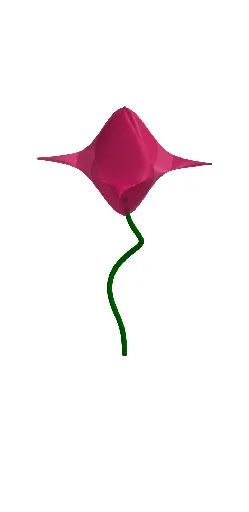
This example demonstrates parametric curves and integral surfaces of an exotic flower. It involves core math concepts like integral calculus, parametric equations, logarithmic functions, median value, difference and slope. Constructed using GeoGebra's CurveCartesian and Surface commands with parameters b, a, c. Suitable for high school and above, ideal for teaching parametric equations and integral surfaces.
GeoGebra Commands & Parameters
CurveCartesian((ℯ^((-(u^(2) / 2))) * sin(u)), (ℯ^((-(u^(2) / 2))) * cos(u)), 1 + u, u, (-π), π) → bSurface(u, (((2 * ℯ^((-(u^(2) / 2)))) * sin(u)) * cos(v)), 5 + (((2 * ℯ^((-(u^(2) / 2)))) * cos(u)) * sin(v)), u, (-π), π, v, 0, (2 * π)) → aSurface((((2 * ℯ^((-(u^(2) / 2)))) * sin(u)) * cos(v)), u, 5 + (((2 * ℯ^((-(u^(2) / 2)))) * cos(u)) * sin(v)), u, (-π), π, v, 0, (2 * π)) → c
AI Drawing Prompt Reference
Draw an exotic flower shape, showcasing parametric curves and integral surfaces. Start by plotting a parametric curve using exponential and trigonometric functions with a range from -π to π. Then, generate two integral surfaces based on this curve, one varying with parameters and the other fixed, to display the flower's 3D structure. The construction highlights the use of integral calculus, parametric equations, and exponential functions, suitable for teaching mathematical concepts.
The prompt above was compiled from the original drawing commands and is for reference only.