
Euler Line and the Polar-Ellipse of a Triangle
Loading the math board and drawing, please wait…
In collections
Besondere Punkte/Special Points
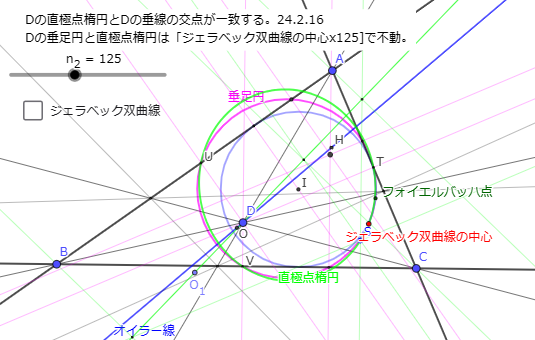
This example demonstrates how to construct and visualize the Euler line of a triangle together with the associated polar-ellipse (the “polar ellipse” determined by the triangle’s configuration). The key ideas are triangle centers and the Euler line collinearity (e.g., relationships among notable points such as the orthocenter/centroid), together with conic geometry: an ellipse arises as a specific second-degree curve tied to the polar construction. Construction in GeoGebra uses Line and TriangleCenter to create the relevant line and triangle center points, Point/Intersect to locate required intersections, and Circle to manage the circle-based setup. OrthogonalLine supplies perpendicular constructions, while Conic plus Locus and LocusEquation generate the ellipse and express/verify it via its conic description or locus equation. Suitable for advanced secondary students, contest geometry practice, and early university analytic geometry on triangle geometry, polar concepts, and conics.
GeoGebra Commands & Parameters
Line(A, B) → fLine(B, C) → gLine(C, A) → hTriangleCenter(A, B, C, 3) → OTriangleCenter(A, B, C, 4) → HLine(O, H) → sPoint(s) → DLine(A, D) → iLine(C, D) → jLine(B, D) → kIntersect(f, j) → EIntersect(g, i) → FIntersect(h, k) → GLine(E, F) → lLine(F, G) → mLine(E, G) → nIntersect(f, m) → H_{1}Intersect(g, n) → I_{1}Line(H_{1}, I_{1}) → pCircle(D, 1) → dPoint(d) → O_{1}Line(D, O_{1}) → tOrthogonalLine(A, t) → aOrthogonalLine(C, t) → bOrthogonalLine(B, t) → eIntersect(t, a) → PIntersect(t, b) → QIntersect(t, e) → ROrthogonalLine(P, g) → f_1OrthogonalLine(R, h) → g_1OrthogonalLine(Q, f) → h_1Intersect(f_1, g_1) → SLocus(S, O_{1}) → loc1OrthogonalLine(D, h) → i_1OrthogonalLine(D, f) → j_1OrthogonalLine(D, g) → k_1Intersect(h, i_1) → TIntersect(j_1, f) → UIntersect(g, k_1) → VCircle(U, V, T) → c_1Intersect(c_1, f, 2) → WIntersect(c_1, g, 2) → ZIntersect(c_1, h, 2) → A_1OrthogonalLine(A_1, h) → l_1OrthogonalLine(W, f) → m_1OrthogonalLine(Z, g) → n_1Intersect(l_1, n_1) → B_1LocusEquation(S, O_{1}) → oTriangleCenter(A, B, C, 11) → MTriangleCenter(A, B, C, n_2) → NTriangleCenter(A, B, C, 1) → IOrthogonalLine(I, f) → p_1Intersect(p_1, f) → D_1Circle(I, D_1) → d_1Conic(A, B, C, O, H) → c
AI Drawing Prompt Reference
Draw a triangle ABC, connect each vertex to the foot of the opposite side, construct the Euler line, find the orthocenter H and centroid O, draw a line through H and O, determine the intersection points of this line with the triangle sides to find point D, use D and circle D(1) to construct a series of perpendicular lines and intersections, ultimately forming an ellipse related to the triangle, and show the relationship between the Euler line and the ellipse.
The prompt above was compiled from the original drawing commands and is for reference only.