
Euler Derivation - Compound Interest
Loading the math board and drawing, please wait…
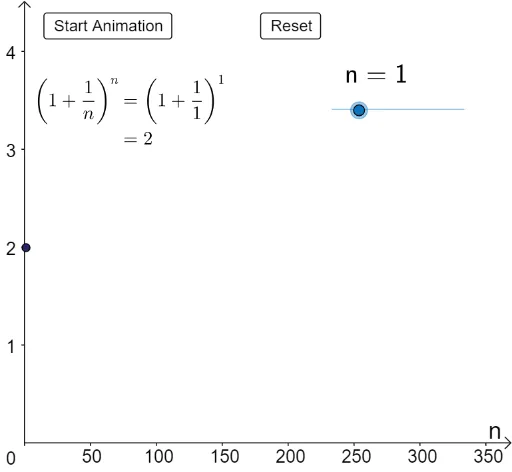
This example demonstrates the application and derivation of Euler's number in continuously compounded interest calculations. It involves core mathematical concepts such as exponential functions, limits, continuous compounding formulas, and derivatives. GeoGebra commands like f, A, B, C, D, E, F, n, a, text1, button1, time, g, h, button2, text2 are used to construct function graphs, parameter animations, and interactive demonstrations. Suitable for high school and above mathematics learners to understand the relationship between continuous compounding and Euler's number, as well as calculus applications.
GeoGebra Commands & Parameters
f(x) = (1 + 1 / x)^(x)(1, f(1))(4, f(4))(12, f(12))(26, f(26))(52, f(52))(365, f(356))Numeric n(1)f(n)Numeric time(2)g(x) = If[1 ≤ x ≤ n, f(x)]h(x) = If[0 ≤ x ≤ 10000, 2.718281828459045]
AI Drawing Prompt Reference
Draw the process of approximating Euler's number e in continuous compounding interest. First, plot the function f(x) = (1 + 1/x)^x, then mark points at x=1, 4, 12, 26, 52, 365. Create a slider n starting from 1 to dynamically show the value of f(n). Finally, draw a horizontal line h(x) = 2.718281828459045 to represent the value of e.
The prompt above was compiled from the original drawing commands and is for reference only.