
Escher-Inspired Patterns
Loading the math board and drawing, please wait…
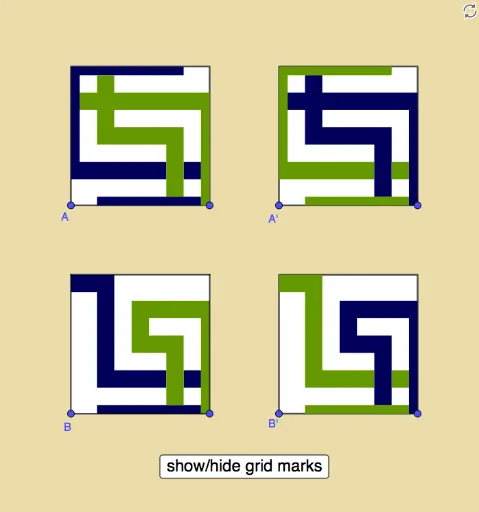
This example demonstrates patterns inspired by Escher. It involves geometric transformations and polygons. Using commands like Polygon, Circle, Intersect, and OrthogonalLine in GeoGebra, complex patterns can be constructed. Suitable for middle school and above students to learn about geometric transformations and pattern construction.
GeoGebra Commands & Parameters
creatingpattern(B', H_4) → I_4, J_4, S_4, S_7, T_7, U_7, V_7, W_7, Z_7, A_8, B_8, C_8, D_8, T_4, E_8, F_8, G_8, H_8, I_8, J_8, K_8, L_8, q3, q4, a_2, q_3, r_3, s_3, t_3, a_3, K_4, c_3, e_3, g_4, h_4, i_4, j_4, l_4, m_4, p_4, q_4, L_4, U_4, V_4, W_4, Z_4, A_5, B_5, C_5, D_5, E_5, F_5, M_4, G_5, H_5, I_5, J_5, K_5, L_5, M_5, N_5, O_5, P_5, N_4, Q_5, R_5, S_5, T_5, U_5, V_5, W_5, Z_5, A_6, B_6, O_4, C_6, D_6, E_6, F_6, G_6, H_6, I_6, J_6, K_6, L_6, P_4, M_6, N_6, O_6, P_6, Q_6, R_6, S_6, T_6, U_6, V_6, Q_4, W_6, Z_6, A_7, B_7, C_7, D_7, E_7, F_7, G_7, H_7, R_4, I_7, J_7, K_7, L_7, M_7, N_7, O_7, P_7, Q_7, R_7Midpoint(F_7, Z_6) → A_{17}Midpoint(J_8, G_8) → S_{12}Polygon(B, B_{17}, 4) → poly2, j, k, l, m, E, FPolygon(B, B_{17}, 4) → poly1, f, g, h, i, C, DCircle(B, (15 * f / 16)) → tIntersect(t, m, 1) → VOrthogonalLine(V, g) → n_3Circle(B, (13 * f / 16)) → sIntersect(s, m, 1) → UMidpoint(V, U) → H_2OrthogonalLine(U, g) → aCircle(B, (11 * f / 16)) → rIntersect(r, j) → N,OrthogonalLine(N, f) → q_1Circle(B, (5 * f / 16)) → eIntersect(e, m, 1) → QOrthogonalLine(Q, g) → h_1Intersect(h_1, q_1) → D_1Intersect(e, j) → K,OrthogonalLine(K, f) → m_1Intersect(m_1, h) → N_1Intersect(h_1, m_1) → B_1Circle(B, (3 * f / 16)) → dIntersect(d, j) → J,OrthogonalLine(J, f) → l_1Intersect(n_3, l_1) → M_2Intersect(a, l_1) → WMidpoint(M_2, W) → M_8Intersect(d, m) → G,OrthogonalLine(G, g) → i_1Intersect(i_1, q_1) → C_1Intersect(i_1, l_1) → ZCircle(B, f / 16) → cCircle(B, (7 * f / 16)) → pCircle(B, (9 * f / 16)) → qIntersect(c, m) → H,Intersect(c, j) → I,Intersect(p, j) → L,Intersect(q, j) → M,Intersect(s, j) → O,Intersect(t, j) → P,Intersect(p, m, 1) → RIntersect(q, m, 1) → SIntersect(r, m, 1) → TOrthogonalLine(T, g) → bOrthogonalLine(S, g) → f_1OrthogonalLine(R, g) → g_1OrthogonalLine(H, g) → j_1OrthogonalLine(I, f) → k_1OrthogonalLine(L, f) → n_1OrthogonalLine(M, f) → p_1OrthogonalLine(O, f) → r_1OrthogonalLine(P, f) → s_1Intersect(j_1, l_1) → A_1Intersect(h_1, r_1) → E_1Intersect(i_1, r_1) → F_1Intersect(j_1, r_1) → G_1Intersect(j_1, s_1) → H_1Intersect(q_1, g_1) → I_1Intersect(f_1, r_1) → J_1Intersect(f_1, p_1) → K_1Intersect(g_1, n_1) → L_1Intersect(h_1, s_1) → M_1Intersect(i_1, s_1) → O_1Intersect(a, g) → P_1Intersect(a, n_1) → Q_1Intersect(b, p_1) → R_1Intersect(b, s_1) → S_1Intersect(q_1, j_1) → T_1Intersect(k_1, h) → U_1Intersect(n_1, h) → V_1Intersect(p_1, h) → W_1Intersect(q_1, h) → A_2Intersect(r_1, h) → B_2Intersect(s_1, h) → E_2Intersect(n_3, g) → Z_1Intersect(l_1, h) → C_2Intersect(b, g) → D_2Intersect(f_1, g) → F_2Intersect(g_1, g) → G_2Intersect(h_1, g) → I_2Intersect(i_1, g) → J_2Intersect(j_1, g) → K_2Intersect(n_3, k_1) → L_2Intersect(n_3, m_1) → N_2Intersect(n_3, n_1) → O_2Intersect(n_3, p_1) → P_2Intersect(n_3, q_1) → Q_2Intersect(n_3, r_1) → R_2Intersect(n_3, s_1) → S_2Intersect(a, s_1) → T_2Intersect(a, r_1) → U_2Intersect(a, q_1) → V_2Intersect(a, p_1) → W_2Intersect(a, m_1) → Z_2Intersect(a, k_1) → A_3Intersect(b, k_1) → B_3Intersect(b, l_1) → C_3Intersect(b, m_1) → D_3Intersect(b, n_1) → E_3Intersect(b, q_1) → F_3Intersect(b, r_1) → G_3Intersect(f_1, s_1) → H_3Intersect(f_1, q_1) → I_3Intersect(n_1, f_1) → J_3Intersect(f_1, m_1) → K_3Intersect(f_1, l_1) → L_3Intersect(f_1, k_1) → M_3Intersect(g_1, k_1) → N_3Intersect(g_1, l_1) → O_3Intersect(g_1, m_1) → P_3Intersect(g_1, p_1) → Q_3Intersect(g_1, r_1) → R_3Intersect(g_1, s_1) → S_3Intersect(h_1, p_1) → T_3Intersect(h_1, n_1) → U_3Intersect(h_1, l_1) → V_3Intersect(h_1, k_1) → W_3Intersect(i_1, k_1) → Z_3Intersect(i_1, m_1) → A_4Intersect(i_1, n_1) → B_4Intersect(i_1, p_1) → C_4Intersect(p_1, j_1) → D_4Intersect(j_1, n_1) → E_4Intersect(j_1, m_1) → F_4Intersect(k_1, j_1) → G_4Segment(V, Z_1) → t_1Segment(U, P_1) → a_1Segment(T, D_2) → b_1Segment(S, F_2) → c_1Segment(R, G_2) → d_1Segment(Q, I_2) → e_1Segment(G, J_2) → f_2Segment(H, K_2) → g_2Segment(U_1, I) → h_2Segment(J, C_2) → i_2Segment(N_1, K) → j_2Segment(L, V_1) → k_2Segment(W_1, M) → l_2Segment(N, A_2) → m_2Segment(B_2, O) → n_2Segment(E_2, P) → p_2Polygon(H_2, M_8, Z, C_1, D_1, B_1, N_1, D) → poly3, b_2, c_2, d_2, d_3, n_4, r_7, s_7, t_7Polygon(J, A_1, H_1, P) → q1, k_3, b_3, f_4, k_4Polygon(E_1, F_1, O_1, M_1) → q2, e_2, f_3, o_1, m_3Polygon(I_4, S_{12}, A_{17}, V_6, D_5, F_5, Z_4, N_4) → poly5, f_5, i_5, n_5, d_5, b_7, c_7, d_7, f_8Polygon(T_1, G_1, L_1, I_1, J_1, K_1, R_1, S_1, P, B_{17}, P_1, Q_1) → poly4, q_2, p_3, k_5, k_6, r_2, s_2, t_2, g_3, h_3, i_3, j_3, l_3Polygon(J_5, M_5, A_7, E_7) → q5, j_5, m_5, a_7, e_7Polygon(E_6, U_4, W_5, K_7) → q6, h_5, e_6, h_7, i_7Polygon(D_8, R_5, N_6, B_6, F_6, J_6, S_7, W_7, K_7, H_4, L_7, O_7) → poly6, r_5, n_7, p_7, q_7, f_6, j_6, n_6, b_6, j_7, k_7, l_7, m_7creatingpattern(A, N_8) → O_8, P_8, A_9, A_{12}, B_{12}, C_{12}, D_{12}, E_{12}, F_{12}, G_{12}, H_{12}, I_{12}, J_{12}, B_9, K_{12}, L_{12}, M_{12}, N_{12}, O_{12}, P_{12}, Q_{12}, R_{12}, q7, q8, r_4, s_4, t_4, a_4, b_4, c_4, Q_8, d_4, e_4, g_5, l_5, p_5, q_5, s_5, t_5, a_5, b_5, R_8, C_9, D_9, E_9, F_9, G_9, H_9, I_9, J_9, K_9, L_9, S_8, M_9, N_9, O_9, P_9, Q_9, R_9, S_9, T_9, U_9, V_9, T_8, W_9, Z_9, A_{10}, B_{10}, C_{10}, D_{10}, E_{10}, F_{10}, G_{10}, H_{10}, U_8, I_{10}, J_{10}, K_{10}, L_{10}, M_{10}, N_{10}, O_{10}, P_{10}, Q_{10}, R_{10}, V_8, S_{10}, T_{10}, U_{10}, V_{10}, W_{10}, Z_{10}, A_{11}, B_{11}, C_{11}, D_{11}, W_8, E_{11}, F_{11}, G_{11}, H_{11}, I_{11}, J_{11}, K_{11}, L_{11}, M_{11}, N_{11}, Z_8, O_{11}, P_{11}, Q_{11}, R_{11}, S_{11}, T_{11}, U_{11}, V_{11}, W_{11}, Z_{11}Polygon(A_9, F_{12}, U_{10}, C_{11}, L_9, J_9, W_9, O_8) → poly7, a_9, f_{12}, u_{10}, c_{11}, l_9, j_9, w_9, o_8Polygon(P_9, S_9, G_{11}, K_{11}) → q9, p_9, s_9, g_{11}, k_{11}Polygon(K_{10}, C_9, E_{10}, Q_{11}) → q10, k_{10}, c_9, e_{10}, q_{11}Polygon(Q_{11}, N_8, I_{11}, H_{10}, J_{12}, Z_9, L_{10}, R_{10}, N_9, E_{12}, R_{11}, B_{11}, O_{11}, L_{11}, F_{11}, D_9, G_9, I_9) → poly8, q_6, i_9, i_{11}, h_{10}, j_{12}, z_9, l_{10}, r_{10}, n_9, e_{12}, n_8, r_{11}, b_{11}, o_{11}, l_{11}, f_{11}, d_9, g_9creatingpattern(A', T_{12}) → U_{12}, V_{12}, G_{13}, G_{16}, H_{16}, I_{16}, J_{16}, K_{16}, L_{16}, M_{16}, N_{16}, O_{16}, P_{16}, H_{13}, Q_{16}, R_{16}, S_{16}, T_{16}, U_{16}, V_{16}, W_{16}, Z_{16}, q11, q12, c_5, e_5, g_6, h_6, i_6, l_6, W_{12}, m_6, p_6, r_6, s_6, t_6, a_6, c_6, d_6, f_7, g_7, Z_{12}, I_{13}, J_{13}, K_{13}, L_{13}, M_{13}, N_{13}, O_{13}, P_{13}, Q_{13}, R_{13}, A_{13}, S_{13}, T_{13}, U_{13}, V_{13}, W_{13}, Z_{13}, A_{14}, B_{14}, C_{14}, D_{14}, B_{13}, E_{14}, F_{14}, G_{14}, H_{14}, I_{14}, J_{14}, K_{14}, L_{14}, M_{14}, N_{14}, C_{13}, O_{14}, P_{14}, Q_{14}, R_{14}, S_{14}, T_{14}, U_{14}, V_{14}, W_{14}, Z_{14}, D_{13}, A_{15}, B_{15}, C_{15}, D_{15}, E_{15}, F_{15}, G_{15}, H_{15}, I_{15}, J_{15}, E_{13}, K_{15}, L_{15}, M_{15}, N_{15}, O_{15}, P_{15}, Q_{15}, R_{15}, S_{15}, T_{15}, F_{13}, U_{15}, V_{15}, W_{15}, Z_{15}, A_{16}, B_{16}, C_{16}, D_{16}, E_{16}, F_{16}Polygon(G_{13}, L_{16}, C_{15}, I_{15}, R_{13}, P_{13}, E_{14}, U_{12}) → poly9, g_{13}, l_{16}, c_{15}, i_{15}, r_{13}, p_{13}, e_{14}, u_{12}Polygon(R_{15}, L_{15}, Z_{14}, T_{13}, K_{16}, W_{15}, T_{12}, Z_{15}, H_{15}, U_{15}, J_{13}, M_{13}, O_{13}, O_{15}, N_{14}, P_{16}, F_{14}, R_{14}) → poly10, r_{15}, r_{14}, z_{14}, t_{13}, k_{16}, w_{15}, t_{12}, z_{15}, h_{15}, u_{15}, l_{15}, j_{13}, m_{13}, o_{13}, o_{15}, n_{14}, p_{16}, f_{14}Polygon(V_{13}, A_{14}, M_{15}, Q_{15}) → q13, v_{13}, a_{14}, m_{15}, q_{15}Polygon(I_{13}, Q_{14}, W_{15}, K_{14}) → q14, i_{13}, q_{14}, w_1, k_{14}LaTeX(button1, true, true) → text1
AI Drawing Prompt Reference
Draw an Escher-inspired geometric pattern featuring multiple polygons and circles. Start by creating several polygons, then draw circles of varying sizes centered at the vertices of these polygons. Next, find the intersections between the circles and the polygon edges, and draw orthogonal lines from these points. Finally, combine all these elements to form a complex, symmetric, and interlocking geometric pattern.
The prompt above was compiled from the original drawing commands and is for reference only.