
Equivalent Fractions Visualized: Random Generation and Graphical Comparison
Loading the math board and drawing, please wait…
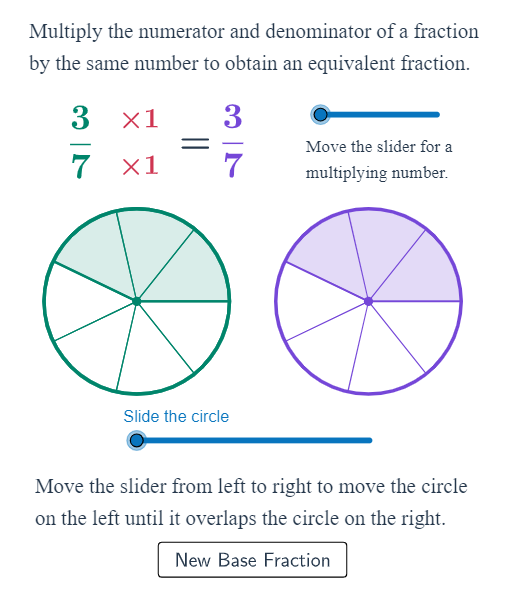
① This example randomly generates numerators and denominators, then uses circular sectors or segmented shapes to visually demonstrate whether two fractions are equivalent. ② The core mathematical concept is fraction equivalence (e.g., 1/2 = 2/4), involving simplification, greatest common divisor (GCD), and proportional reasoning. ③ Construction highlights: GeoGebra commands include Random for generating values, GCD for simplification, Point, Segment, Circle, Sector to draw fraction representations, Sequence to create multiple divisions, Translate and Vector for moving parts, and text objects (text1, text2, etc.) to display fraction expressions and comparison results. ④ Suitable for upper elementary to middle school students learning fraction concepts, and useful for classroom demonstrations or self-guided exploration of equivalent fraction patterns.
GeoGebra Commands & Parameters
Random(2, 12) → denom_1Random(1, denom_1 - 1) → numer_1GCD(numer_1, denom_1) → tPoint(xAxis) → BSegment(B, A) → aPoint(a) → CCircle(C, 4) → dSequence(m, m, 1, denom - 1, 1) → list3, {1, 2, 3, 4, 5, 6}Sequence(Segment[C, C + ((4 * cos(α°)), (4 * sin(α°)))], α, 0, 360, 360 / denom) → list2, {4, 4, 3.9999999999999996, 3.9999999999999996, 3.9999999999999996, 4, 4, 4}Sector(d, 0, ((numer * 360) * ° / denom)) → eRandom(2, ceil(24 / denom)) → multTranslate(d, Vector[B, (f, 0)]) → d'_1Vector(B, (f, 0)) → uTranslate(e, u) → e'Translate(list2, u) → list2'Sequence(Segment[A, A + ((4 * cos(α°)), (4 * sin(α°)))], α, 0, 360, 360 / ((g * denom))) → list1, {4, 3.9999999999999996, 3.9999999999999996, 3.9999999999999996, 3.9999999999999996, 4, 4.000000000000001, 4}Sector(c, 0, (((g * numer) * 360) * ° / ((g * denom)))) → e_1
AI Drawing Prompt Reference
On the same coordinate plane, create a visual comparison of equivalent fractions. First select a numerator and denominator, compute their greatest common divisor to obtain the simplified form, and use proportional reasoning. Draw a baseline and a key point, then construct a circle centered at that point with radius 4. Divide the circle into equal angular sectors according to the denominator and highlight a sector whose angle corresponds to the fraction numerator/denominator. Next, replicate the segmentation for the simplified fraction and shift one representation sideways so the two fraction-area displays sit side by side. Add text labels showing the fraction expressions and any equivalence/comparison result.
The prompt above was compiled from the original drawing commands and is for reference only.