
Simulating VOR Beacon Antenna Switching Sequence with Dynamic Colors
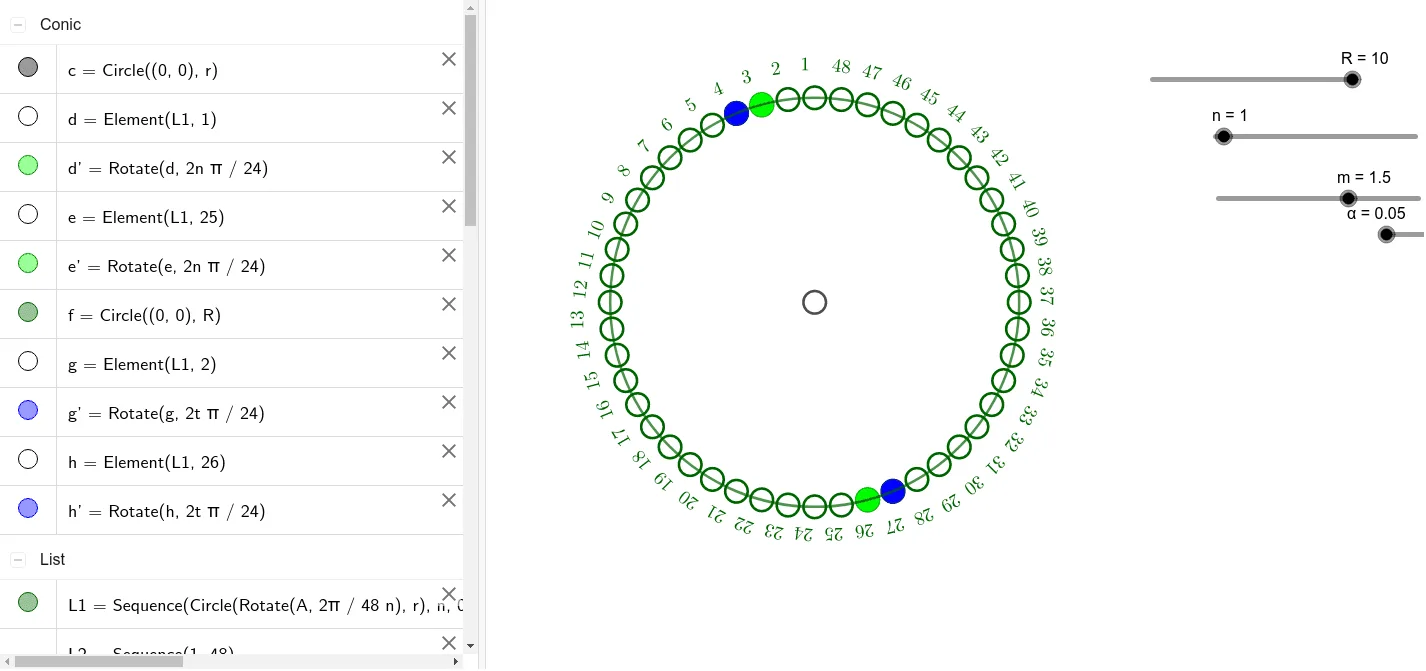
This example simulates the antenna switching sequence of a VHF Omnidirectional Range (VOR) navigation beacon. Multiple antenna elements are arranged in a circular array using Sequence and Rotate commands to achieve rotational positioning and sequential activation, with dynamic color adjustments visualizing the signal transmission process. It demonstrates applications of circular rotational symmetry, sequence generation, and geometric transformations in navigation technology. The applet covers polygon vertex distribution, angle calculations, and dynamic animation control. Students can observe how each antenna element is activated in a rotating sequence to create the illusion of a sweeping signal beam, mirroring the real-world operation of a VOR beacon used in aviation navigation. By manipulating the number of antenna elements and the switching speed, learners can explore how the density and timing of the antenna array affect the rotational symmetry and the smoothness of the simulated signal sweep. The dynamic color changes provide an intuitive visual representation of which antenna is currently active, reinforcing the connection between the abstract geometric construction and its practical application in radio navigation. This interactive model serves as an educational bridge between pure mathematics concepts such as rotation, symmetry, and sequences, and their real-world engineering implementation in aircraft navigation systems.
In collections
Integrating GeoGebra in Junior High Math
Loading the math board and drawing, please wait…