
Equivalent Fractions Puzzle: Drag and Explore Fraction Equivalence
Loading the math board and drawing, please wait…
In collections
Primary School Mathematics Collection
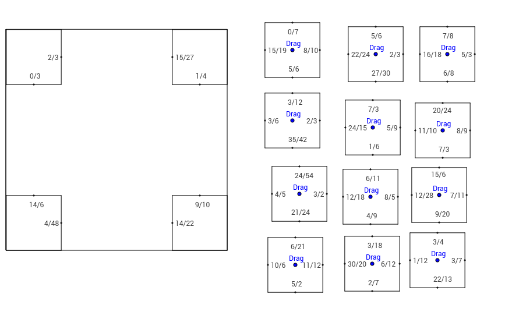
This example demonstrates the concept of equivalent fractions through an interactive geometric puzzle. Users can drag the "Drag" point on each square to explore how circles, points, segments, orthogonal lines, intersections, mirrors, and midpoints are used in GeoGebra to construct and visualize fraction equivalence. The core mathematical ideas include the fundamental properties of fractions, proportional relationships, and graphical verification, making it suitable for elementary and middle school mathematics classes as well as math contest preparation.
GeoGebra Commands & Parameters
Circle(A, 2) → cPoint(c) → BSegment(A, B) → aOrthogonalLine(A, a) → bIntersect(c, b) → C, DMirror(B, b) → B'Segment(B', D) → dSegment(D, B) → eSegment(B, C) → fSegment(B', C) → gMidpoint(f) → EMidpoint(e) → FMidpoint(d) → GMidpoint(g) → HCircle(A_1, 2) → c_1Point(c_1) → B_1Segment(A_1, B_1) → a_1OrthogonalLine(A_1, a_1) → b_1Intersect(c_1, b_1) → C_1, D_1Mirror(B_1, b_1) → B'_1Segment(B'_1, D_1) → d_1Segment(D_1, B_1) → e_1Segment(B_1, C_1) → f_1Segment(B'_1, C_1) → g_1Midpoint(f_1) → E_1Midpoint(e_1) → F_1Midpoint(d_1) → G_1Midpoint(g_1) → H_1Circle(A_4, 2) → c_4Point(c_4) → B_7Segment(A_4, B_7) → a_4OrthogonalLine(A_4, a_4) → b_4Intersect(c_4, b_4) → C_7, D_7Mirror(B_7, b_4) → B'_7Segment(B'_7, D_7) → d_4Segment(D_7, B_7) → e_4Segment(B_7, C_7) → f_4Segment(B'_7, C_7) → g_4Midpoint(f_4) → E_4Midpoint(e_4) → F_4Circle(A_5, 2) → c_5Point(c_5) → B_6Segment(A_5, B_6) → a_5OrthogonalLine(A_5, a_5) → b_5Intersect(c_5, b_5) → C_6, D_6Mirror(B_6, b_5) → B'_6Segment(B'_6, D_6) → d_5Segment(D_6, B_6) → e_5Segment(B_6, C_6) → f_5Segment(B'_6, C_6) → g_5Midpoint(f_5) → E_5Midpoint(e_5) → F_5Midpoint(d_5) → G_5Midpoint(g_5) → H_5Circle(A_6, 2) → c_6Point(c_6) → B_5Segment(A_6, B_5) → a_6OrthogonalLine(A_6, a_6) → b_6Intersect(c_6, b_6) → C_5, D_5Mirror(B_5, b_6) → B'_5Segment(B'_5, D_5) → d_6Segment(D_5, B_5) → e_6Segment(B_5, C_5) → f_6Segment(B'_5, C_5) → g_6Midpoint(f_6) → E_6Midpoint(e_6) → F_6Midpoint(d_6) → G_6Midpoint(g_6) → H_6Circle(A_7, 2) → c_7Point(c_7) → B_4Segment(A_7, B_4) → a_7OrthogonalLine(A_7, a_7) → b_7Intersect(c_7, b_7) → C_4, D_4Mirror(B_4, b_7) → B'_4Segment(B'_4, D_4) → d_7Segment(D_4, B_4) → e_7Segment(B_4, C_4) → f_7Segment(B'_4, C_4) → g_7Midpoint(e_7) → F_7Midpoint(d_7) → G_7Midpoint(g_7) → H_7Circle(A_8, 2) → c_8Point(c_8) → B_{15}Segment(A_8, B_{15}) → a_8OrthogonalLine(A_8, a_8) → b_8Intersect(c_8, b_8) → C_{15}, D_{15}Mirror(B_{15}, b_8) → B'_{15}Segment(B'_{15}, D_{15}) → d_8Segment(D_{15}, B_{15}) → e_8Segment(B_{15}, C_{15}) → f_8Segment(B'_{15}, C_{15}) → g_8Midpoint(f_8) → E_8Midpoint(e_8) → F_8Midpoint(d_8) → G_8Midpoint(g_8) → H_8Circle(A_9, 2) → c_9Point(c_9) → B_{14}Segment(A_9, B_{14}) → a_9OrthogonalLine(A_9, a_9) → b_9Intersect(c_9, b_9) → C_{14}, D_{14}Mirror(B_{14}, b_9) → B'_{14}Segment(B'_{14}, D_{14}) → d_9Segment(D_{14}, B_{14}) → e_9Segment(B_{14}, C_{14}) → f_9Segment(B'_{14}, C_{14}) → g_9Midpoint(f_9) → E_9Midpoint(e_9) → F_9Midpoint(d_9) → G_9Midpoint(g_9) → H_9Circle(A_{12}, 2) → c_{12}Point(c_{12}) → B_{11}Segment(A_{12}, B_{11}) → a_{12}OrthogonalLine(A_{12}, a_{12}) → b_{12}Intersect(c_{12}, b_{12}) → C_{11}, D_{11}Mirror(B_{11}, b_{12}) → B'_{11}Segment(B'_{11}, D_{11}) → d_{12}Segment(D_{11}, B_{11}) → e_{12}Segment(B_{11}, C_{11}) → f_{12}Segment(B'_{11}, C_{11}) → g_{12}Midpoint(f_{12}) → E_{12}Midpoint(e_{12}) → F_{12}Midpoint(d_{12}) → G_{12}Midpoint(g_{12}) → H_{12}Circle(A_{13}, 2) → c_{13}Point(c_{13}) → B_{10}Segment(A_{13}, B_{10}) → a_{13}OrthogonalLine(A_{13}, a_{13}) → b_{13}Intersect(c_{13}, b_{13}) → C_{10}, D_{10}Mirror(B_{10}, b_{13}) → B'_{10}Segment(B'_{10}, D_{10}) → d_{13}Segment(D_{10}, B_{10}) → e_{13}Segment(B_{10}, C_{10}) → f_{13}Segment(B'_{10}, C_{10}) → g_{13}Midpoint(f_{13}) → E_{13}Midpoint(e_{13}) → F_{13}Midpoint(d_{13}) → G_{13}Midpoint(g_{13}) → H_{13}Circle(A_{14}, 2) → c_{14}Point(c_{14}) → B_9Segment(A_{14}, B_9) → a_{14}OrthogonalLine(A_{14}, a_{14}) → b_{14}Intersect(c_{14}, b_{14}) → C_9, D_9Mirror(B_9, b_{14}) → B'_9Segment(B'_9, D_9) → d_{14}Segment(D_9, B_9) → e_{14}Segment(B_9, C_9) → f_{14}Segment(B'_9, C_9) → g_{14}Midpoint(e_{14}) → F_{14}Midpoint(d_{14}) → G_{14}Circle(A_{15}, 2) → c_{15}Point(c_{15}) → B_8Segment(A_{15}, B_8) → a_{15}OrthogonalLine(A_{15}, a_{15}) → b_{15}Intersect(c_{15}, b_{15}) → C_8, D_8Mirror(B_8, b_{15}) → B'_8Segment(B'_8, D_8) → d_{15}Segment(D_8, B_8) → e_{15}Segment(B_8, C_8) → f_{15}Segment(B'_8, C_8) → g_{15}Midpoint(f_{15}) → E_{15}Midpoint(e_{15}) → F_{15}Midpoint(d_{15}) → G_{15}Midpoint(g_{15}) → H_{15}Circle(A_{16}, 2) → c_{16}Point(c_{16}) → B_{19}Segment(A_{16}, B_{19}) → a_{16}OrthogonalLine(A_{16}, a_{16}) → b_{16}Intersect(c_{16}, b_{16}) → C_{19}, D_{19}Mirror(B_{19}, b_{16}) → B'_{19}Segment(B'_{19}, D_{19}) → d_{16}Segment(D_{19}, B_{19}) → e_{16}Segment(B_{19}, C_{19}) → f_{16}Segment(B'_{19}, C_{19}) → g_{16}Midpoint(f_{16}) → E_{16}Midpoint(e_{16}) → F_{16}Midpoint(d_{16}) → G_{16}Midpoint(g_{16}) → H_{16}Circle(A_{17}, 2) → c_{17}Point(c_{17}) → B_{18}Segment(A_{17}, B_{18}) → a_{17}OrthogonalLine(A_{17}, a_{17}) → b_{17}Intersect(c_{17}, b_{17}) → C_{18}, D_{18}Mirror(B_{18}, b_{17}) → B'_{18}Segment(B'_{18}, D_{18}) → d_{17}Segment(D_{18}, B_{18}) → e_{17}Segment(B_{18}, C_{18}) → f_{17}Segment(B'_{18}, C_{18}) → g_{17}Midpoint(d_{17}) → G_{17}Midpoint(g_{17}) → H_{17}Circle(A_{18}, 2) → c_{18}Point(c_{18}) → B_{17}Segment(A_{18}, B_{17}) → a_{18}OrthogonalLine(A_{18}, a_{18}) → b_{18}Intersect(c_{18}, b_{18}) → C_{17}, D_{17}Mirror(B_{17}, b_{18}) → B'_{17}Segment(B'_{17}, D_{17}) → d_{18}Segment(D_{17}, B_{17}) → e_{18}Segment(B_{17}, C_{17}) → f_{18}Segment(B'_{17}, C_{17}) → g_{18}Midpoint(f_{18}) → E_{18}Midpoint(g_{18}) → H_{18}Circle(A_{19}, 2) → c_{19}Point(c_{19}) → B_{16}Segment(A_{19}, B_{16}) → a_{19}OrthogonalLine(A_{19}, a_{19}) → b_{19}Intersect(c_{19}, b_{19}) → C_{16}, D_{16}Mirror(B_{16}, b_{19}) → B'_{16}Segment(B'_{16}, D_{16}) → d_{19}Segment(D_{16}, B_{16}) → e_{19}Segment(B_{16}, C_{16}) → f_{19}Segment(B'_{16}, C_{16}) → g_{19}Midpoint(f_{19}) → E_{19}Midpoint(e_{19}) → F_{19}Midpoint(d_{19}) → G_{19}Midpoint(g_{19}) → H_{19}Midpoint(f_7) → ISegment(J, K) → hOrthogonalLine(J, h) → iOrthogonalLine(K, h) → jPoint(i) → LOrthogonalLine(L, i) → kIntersect(j, k) → MSegment(J, L) → lSegment(L, M) → mSegment(M, K) → nSegment(K, J) → p
AI Drawing Prompt Reference
Draw a geometric puzzle to explore fraction equivalence by dragging points. In two squares, draw circles, points, segments, and perpendicular lines, find intersections, mirror points, and connect them to form new segments. Calculate midpoints of segments, draw new circles and segments. Show how geometric construction and graphical verification can demonstrate fraction equivalence, suitable for elementary and middle school students learning fundamental properties of fractions, proportional relationships, and graphical proof.
The prompt above was compiled from the original drawing commands and is for reference only.