
Equal Cross Sections of Two Triangular Pyramids
Loading the math board and drawing, please wait…
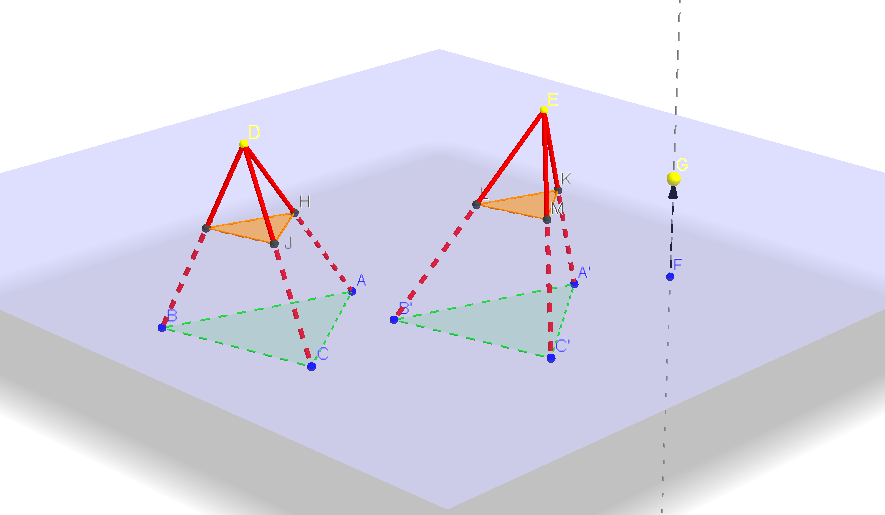
This example demonstrates the equal cross sections of two triangular pyramids with the same base and height. Key mathematical concepts include the volume calculation and properties of equal cross sections in solid geometry. Using GeoGebra commands such as Polygon, Vector, Translate, etc., the construction and properties of the triangular pyramids are visually explained. Suitable for high school mathematics education and learning.
GeoGebra Commands & Parameters
Polygon(A, B, C) → poly1, c, a, bVector(A, A') → uTranslate(poly1, u) → poly1'Translate(C, u) → C'Translate(B, u) → B'OrthogonalPlane(D, zAxis) → dPointIn(d) → EPyramid(poly1, D) → e, faceABD, faceBCD, faceACD, edgeAD, edgeBD, edgeCDPyramid(poly1', E) → f, face1, face3, face2, edge1, edge2, edge3OrthogonalLine(F, xOyPlane) → gPoint(g) → GVector(F, G) → wOrthogonalPlane(G, g) → hIntersectPath(h, e) → poly2, H, I, J, i, j, kIntersectPath(h, f) → poly3, K, L, M, l, m, n
AI Drawing Prompt Reference
Draw two triangular pyramids with the same base and height to demonstrate equal cross sections. First, draw a triangular pyramid and a parallel triangle section to its base. Then, draw another triangular pyramid with its apex on the triangle section. Connect the apex to the points on the triangle section to form the cross sections of both pyramids. Finally, draw a plane parallel to the cross section and intersect it with both pyramids to show equal cross sections.
The prompt above was compiled from the original drawing commands and is for reference only.