
Clairaut's Theorem and Triangle Angle Sum
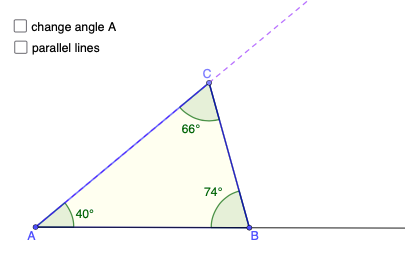
Loading the math board and drawing, please wait…
In collections
About angles in a triangle
This example dynamically demonstrates Clairaut's Theorem in triangles, illustrating the relationship between a triangle's area, side lengths, and included angles. Key math concepts include the triangle angle sum theorem, Clairaut's theorem, geometric construction, and dynamic geometry. Construction highlights from the GeoGebra summary include commands like Line, Circle, Point, Ray, Segment, Angle, and Polygon. Suitable for high school mathematics education to help students understand geometric properties and the application of Clairaut's theorem.
GeoGebra Commands & Parameters
Line(A, B) → fCircle(A, 1) → cPoint(c) → GRay(A, G) → gPoint(g) → CSegment(C, B) → hAngle(A, B, C) → αAngle(B, C, A) → βAngle(B, A, C) → γLine(B, g) → iPolygon(A, B, C) → t1, c_1, a, bRay(A, B) → j
AI Drawing Prompt Reference
Draw a triangle with a horizontal base. Place a unit circle at the left endpoint of the base, pick a point on the circle, and draw a ray from that point to form one side of the triangle, connecting to the right endpoint of the base. Label the three interior angles. Then draw a line through the right endpoint parallel to the ray. Finally, fill the triangle as a polygon and extend the base line.
The prompt above was compiled from the original drawing commands and is for reference only.