
Epsilon Eridani: Polyhedron and Circle Construction
Loading the math board and drawing, please wait…
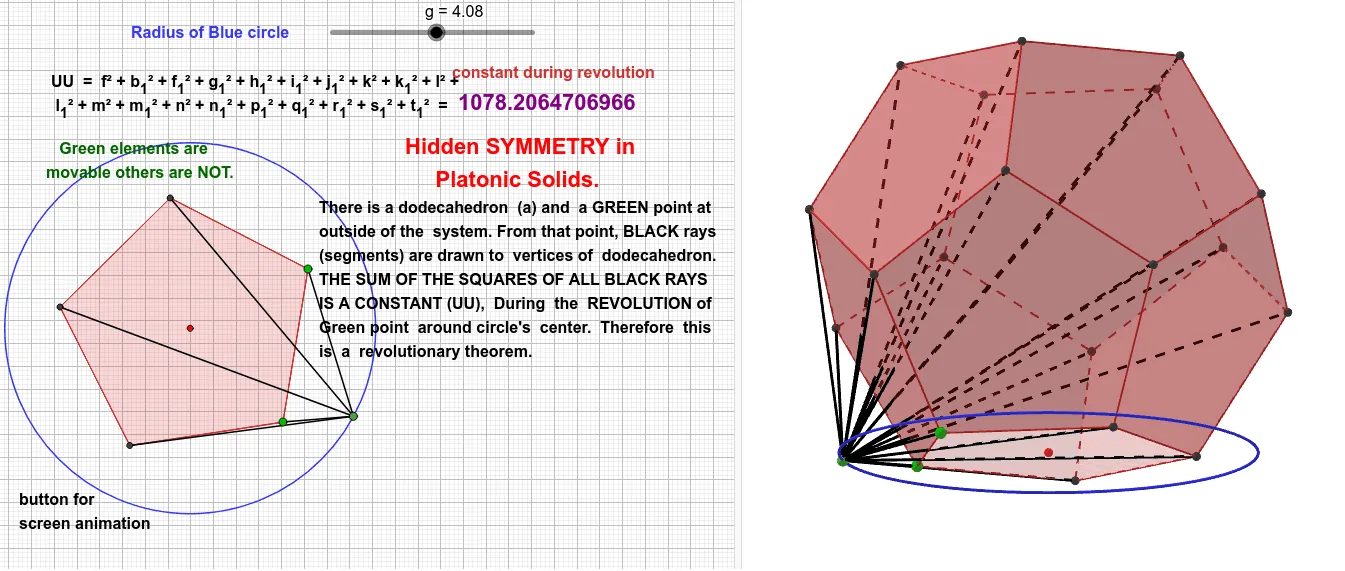
This GeoGebra example, titled 'Epsilon Eridani', showcases a sophisticated 3D geometric construction that integrates a regular dodecahedron, polygons, circles, and centroids. The core mathematical concepts involve polyhedra (specifically the regular dodecahedron), polygon properties, circle centers, centroids (barycenters), symmetry, and geometric transformations. The construction uses GeoGebra commands such as Polygon, Dodecahedron, Midpoint, Centroid, Circle, Point, and Segment, with objects including vertices labeled A through T, faces like faceAEIOJ, and text elements. This example is ideal for high school or university students studying solid geometry, polyhedron characteristics, and symmetry, and can also serve as a mathematical art piece or a tool for exploring spatial relationships among points, lines, planes, and circles in three-dimensional space.
GeoGebra Commands & Parameters
Polygon(A, B, 5) → poly1, f_2, g_2, h_2, i, j, C, D, EDodecahedron(poly1, true) → a, F, O, P, Q, R, S, T, faceAEIOJ, faceABFKJ, faceBCGLF, faceCDHMG, G, faceDEINH, faceINSTO, faceJKPTO, faceFKPQL, faceGLQRM, faceHMRSN, facePQRST, edgeAJ, edgeEI, edgeIO, H, edgeJO, edgeJK, edgeFK, edgeBF, edgeFL, edgeGL, edgeCG, edgeGM, edgeHM, edgeDH, I, edgeHN, edgeIN, edgeNS, edgeST, edgeOT, edgePT, edgeKP, edgePQ, edgeLQ, edgeQR, J, edgeMR, edgeRS, K, L, M, NPolygon(D, E, A, B, C) → poly2, d, e, a_1, b, cMidpoint(D, E) → UMidpoint(D, C) → VMidpoint(E, A) → WMidpoint(E, I) → ZMidpoint(I, O) → A_1Midpoint(O, J) → B_1Centroid(poly1) → C_1Circle(C_1, g) → hPoint(h) → F_1Segment(L, F_1) → kSegment(G, F_1) → lSegment(F, F_1) → mSegment(C, F_1) → nSegment(B, F_1) → f_1Segment(Q, F_1) → g_1Segment(R, F_1) → h_1Segment(S, F_1) → i_1Segment(K, F_1) → j_1Segment(H, F_1) → k_1Segment(D, F_1) → l_1Segment(E, F_1) → m_1Segment(M, F_1) → n_1Segment(N, F_1) → p_1Segment(O, F_1) → q_1Segment(I, F_1) → r_1Segment(P, F_1) → s_1Segment(A, F_1) → t_1Segment(J, F_1) → b_1Segment(T, F_1) → f
AI Drawing Prompt Reference
Draw a regular dodecahedron with a regular pentagon as its base. Inside the dodecahedron, connect the base vertices with adjacent vertices to form another pentagon. Take midpoints of the base pentagon's edges and midpoints of adjacent edges, and find the centroid of the base pentagon. Using this centroid as the center, draw a circle passing through a vertex of the base pentagon, and place a point on this circle. From this point, draw segments to all vertices of the dodecahedron (including base vertices, inner pentagon vertices, and other dodecahedron vertices), creating a radial structure. The overall composition is a symmetric 3D geometric figure involving a polyhedron, polygons, a circle, and centroids.
The prompt above was compiled from the original drawing commands and is for reference only.