
Ellipse: Magic Sum by Tim Brzezinski
Loading the math board and drawing, please wait…
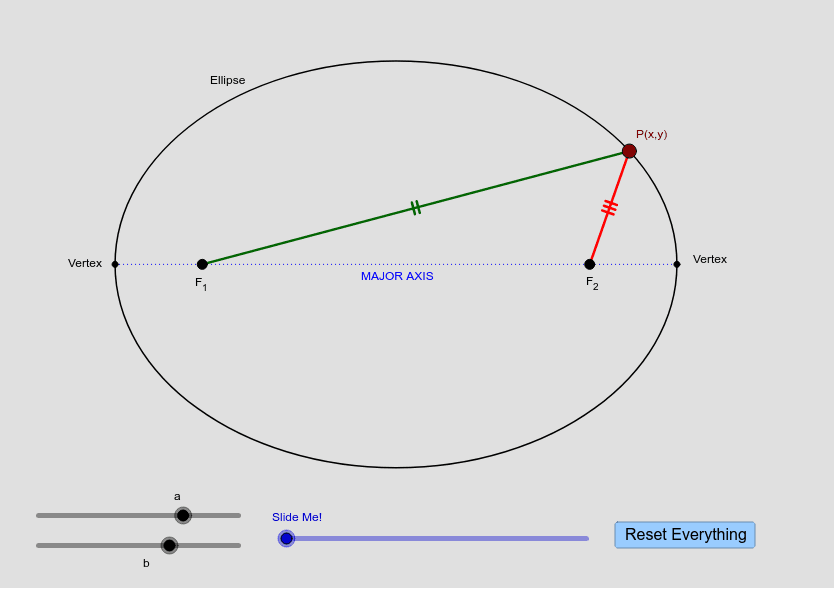
This example demonstrates an interesting property of ellipses: the sum of the distances from any point on the ellipse to its two foci is constant. Key mathematical concepts include the definition of an ellipse, foci, and vertices. The construction uses GeoGebra commands such as Focus, Vertex, Segment, Translate, etc. Suitable for high school mathematics education and learning about ellipse properties.
GeoGebra Commands & Parameters
Focus(c) → F_1, F_2Vertex(c) → C, D, E, FSegment(C, D) → dTranslate(C, (0, b + 4)) → C'Translate(D, (0, b + 4)) → D'Point(c) → GSegment(G, F_1) → eSegment(G, F_2) → fTranslate(C, (b + 4, 0)) → C'_1Vector(C, C') → uVector(D, D') → vDilate(C, If[0 < n < 1, 1 - n, 0], C') → C'_2Dilate(D, If[0 < n < 1, 1 - n, 0], D') → D'_2Dilate(F_1, If[1 < n < 2, 2 - n, 1], C') → A'Vector(F_1, A') → wTranslate(G, w) → G'Segment(A', G') → mAngle(F_2, F_1, G) → αRotate(A', If[1 < n < 2, ((-(2 - n)) * α)], A') → A''Rotate(A', If[1 < n < 2, ((-(n - 2)) * α), 0], A'') → A''_1Rotate(A', If[1 < n < 2, ((-(n - 1)) * α), (-α)], A') → A''_2Rotate(G', If[1 < n < 2, ((-(n - 1)) * α), (-α)], A') → G''Circle(C', e) → qSegment(F_1, G) → sDilate(F_2, If[2 < n < 3, 3 - n, 1], D') → B'Vector(F_2, B') → tTranslate(G, t) → G'_2Translate(F_2, t) → B'_1Segment(G'_2, B'_1) → f'Angle(G, F_2, F_1) → βRotate(G'_2, If[2 < n < 3, ((n - 2) * β)], B') → LRotate(B'_1, If[2 < n < 3, ((n - 2) * β)], B') → MSegment(G, F_2) → b_1Center(c) → ASegment(A, G) → c_1Segment(A, G) → d_1Dilate(A, If[1 < n < 2, 2 - n, 0], C') → A'_1Vector(F_1, A'_1) → u_1Translate(A, u_1) → A'_2Angle(D, F_1, G) → γRotate(A'_2, ((-(n - 1)) * γ), A'_2) → BCircle(C, e) → pIntersect(p, d, 1) → HDilate(F_1, If[0 < n < 1, 1 - n, 1], C) → IVector(F_1, I) → lTranslate(G, l) → G'_1Translate(F_1, l) → JSegment(G'_1, J) → e'Rotate(G'_1, If[0 < n < 1, (-((n * α))), (-α)], I) → KRotate(J, If[0 < n < 1, (-((n * α))), (-α)], I) → J'Segment(K, J') → e''Segment(C, H) → rDilate(F_2, If[1 < n < 2, 2 - n, 1], D) → NVector(F_2, N) → v_1Translate(G, v_1) → G'_3Translate(F_2, v_1) → OSegment(G'_3, O) → f'_1Rotate(G'_3, If[1 < n < 2, ((n - 1) * β), β], N) → PRotate(O, If[1 < n < 2, ((n - 1) * β), β], N) → O'Segment(P, O') → a_1Segment(D, H) → e_1Dilate(F_1, 1 - n, C) → QVector(F_1, Q) → hTranslate(A, h) → A'_3Translate(G, h) → G'_4Segment(A'_3, G'_4) → iAngle(D, Center[c], G) → δRotate(A'_3, If[0 < n < 1, (-((n * δ)))], Q) → RRotate(G'_4, If[0 < n < 1, (-((n * δ)))], Q) → SSegment(R, S) → i'Dilate(F_2, If[1 < n < 2, 2 - n], D) → TVector(F_1, T) → w_1Translate(A, w_1) → A'_4Translate(G, w_1) → G'_5Segment(A'_4, G'_5) → f_1Angle(G, Center[c], C) → εRotate(A'_4, If[1 < n < 2, ((n - 1) * ε)], A'_4) → URotate(G'_5, If[1 < n < 2, ((n - 1) * ε)], A'_4) → VSegment(U, V) → g_1