
Ellipse as a Locus: The Gardener's Method
Loading the math board and drawing, please wait…
In collections
circles, ovals, ellipses and architecture
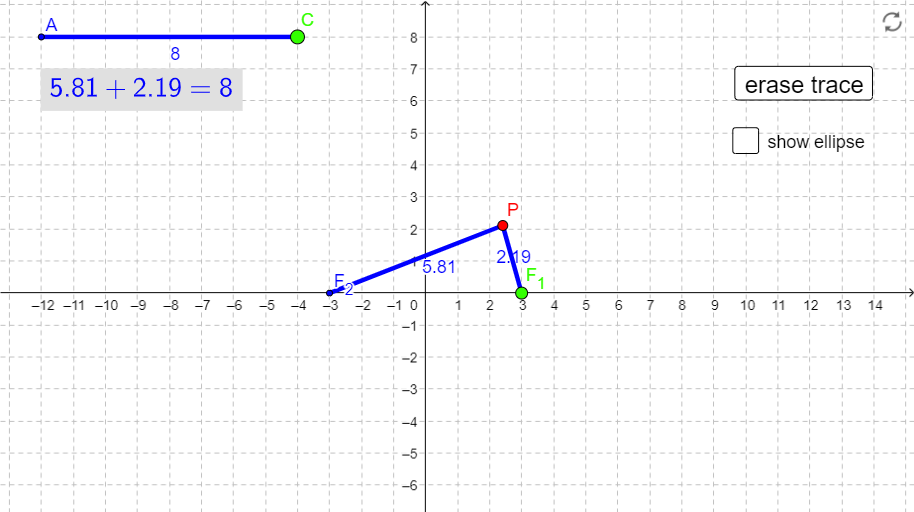
This example demonstrates the geometric construction of an ellipse as a locus. Key mathematical concepts include the definition of an ellipse, the constant sum of distances from two foci, coordinate geometry, and graphing functions. Construction involves GeoGebra commands such as Point, Mirror, Distance, Segment, and Ellipse to create ellipse objects. Suitable for high school students or math enthusiasts to understand ellipse properties and construction techniques.
GeoGebra Commands & Parameters
Point(xAxis) → F_1Mirror(F_1, O) → F_2Distance(F_1, F_2) → lPoint(Ray[B, B + (1, 0)]) → CSegment(A, C) → fEllipse(F_1, F_2, f / 2) → cPoint(c) → PSegment(F_2, P) → gSegment(P, F_1) → h
AI Drawing Prompt Reference
Create an illustration of constructing an ellipse using the gardener’s method. Start with a point F1 on a given axis, and form the second focus F2 as the mirror image of F1 with respect to point O. Let l be the distance between F1 and F2. Next, choose a point C on a horizontal ray starting from B in the direction (1,0), and draw segment f as the connection from A to C. Construct the ellipse c that uses F1 and F2 as its foci and has the required constant-distance condition corresponding to f/2. Then select a point P on the ellipse and draw segments from P to F2 and from P to F1 (g and h) to visually indicate the distance-to-foci relationship for points on the ellipse.
The prompt above was compiled from the original drawing commands and is for reference only.