
Effect of Increasing Isosceles Triangle Sides on Perimeter
Loading the math board and drawing, please wait…
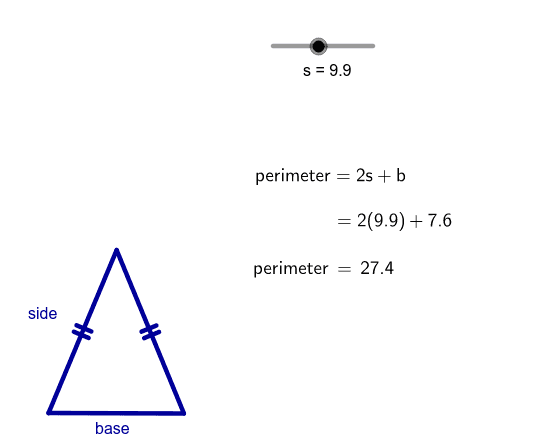
This example demonstrates the impact of increasing the congruent sides of an isosceles triangle on its perimeter calculation expression. Key math concepts include perimeter computation, properties of isosceles triangles, and variable relationships. Constructed using GeoGebra commands like Segment, Circle, Intersect, and LaTeX, involving objects such as points A, B, base, s, c, d, C, side, perimeter, and text elements. Suitable for high school students to explore how changes in geometric properties affect calculations.
GeoGebra Commands & Parameters
Segment(A, B) → baseCircle(A, s) → cCircle(B, Radius[c]) → dIntersect(c, d, 1) → CSegment(A, C) → sideSegment(C, B) → fLaTeX(perimeter, true, true) → text1
AI Drawing Prompt Reference
Draw an isosceles triangle to illustrate how changes in the lengths of its congruent sides affect the perimeter. Start by drawing the base, then create two equal circles centered at the endpoints of the base. The intersection point of the circles becomes the apex of the triangle. Connect the apex to the base endpoints to form the triangle. Include a text label for the perimeter calculation expression and dynamically show how the perimeter changes as the side lengths vary.
The prompt above was compiled from the original drawing commands and is for reference only.