
Dynamic Triangle Area Exploration
Loading the math board and drawing, please wait…
In collections
Congruence (CO) Cluster
CCSS High School: Geometry (Congruence) Volume 2
CCSS High School: Geometry (Congruence) Volume 2
CCSS High School: Geometry (Congruence) Volume 2
Perimeter & Area
Area
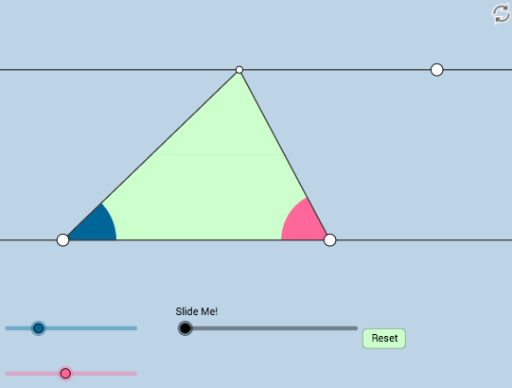
This example demonstrates how to dynamically calculate and modify the area of a triangle. Key math concepts include triangle area formulas, dynamic geometric transformations, and angle calculations. Construction highlights involve commands like Rotate, Angle, Segment, Intersect, Midpoint, Line, OrthogonalLine, Polygon, Point, Circle, Dilate, Min, CircleSector, Vector, and Translate in GeoGebra. It is suitable for high school mathematics education, exploring the relationship between triangle area, side lengths, and angles to deepen understanding of area formulas.
GeoGebra Commands & Parameters
Rotate(A, α, B) → A'Angle(A, B, A') → γRay(B, A') → fRotate(B, (-β), A) → B'Angle(B', A, B) → δRay(A, B') → gSegment(B, A) → hIntersect(f, g) → CSegment(B, C) → iSegment(A, C) → jMidpoint(i) → DMidpoint(j) → ELine(B, A) → lOrthogonalLine(C, l) → mIntersect(l, m) → FSegment(C, F) → nPolygon(D, E, C) → poly1, c, d, eMidpoint(n) → GLine(C, l) → pPolygon(B, D, E, A) → poly2, b, d_1, e_1, aSegment(D, C) → qSegment(B, A) → rPoint(p) → HOrthogonalLine(H, p) → tIntersect(l, t) → ISegment(H, I) → sCircle(I, 3) → c_1Circle(H, 3) → f_1Intersect(f_1, p, 1) → JIntersect(f_1, p, 2) → KIntersect(c_1, l, 2) → LIntersect(c_1, s, 1) → MIntersect(c_1, l, 1) → NAngle(J, H, I) → εAngle(M, I, N) → ζDilate(H, If[0 < k ≤ 1, 1 - k, 0], I) → H'Segment(H, H') → g_1Angle(C, F, B) → ηDilate(C, If[1 < k ≤ 2, 2 - k, 0], G) → C'Segment(C, C') → h_1Dilate(G, If[2 < k ≤ 3, 3 - k, 0], F) → G'Segment(G, G') → i_1Rotate(C, If[3 < k ≤ 4, ((-(k - 3)) * π), (-π)], G) → C'_1Rotate(C', If[3 < k ≤ 4, ((-(k - 3)) * π), (-π)], G) → C''Segment(C'_1, C'') → j_1Dilate(G, If[4 < k ≤ 5, 5 - k, 0], D) → G'_1Dilate(G, If[4 < k ≤ 5, 5 - k, 0], E) → G'_2Segment(G, G'_1) → k_1Segment(G, G'_2) → l_1Segment(B, F) → m_1Segment(B, D) → n_1Segment(D, G) → p_1Segment(D, C) → q_1Min({m_1, n_1, p_1, q_1}) → oCircle(B, (0.6 * o)) → r_1Intersect(r_1, l) → O, PSegment(B, C) → s_1Intersect(r_1, s_1, 1) → QCircleSector(B, P, Q) → t_1Rotate(D, If[6 < k ≤ 7, ((-(k - 6)) * π), (-π)], E) → D'Rotate(E, If[6 < k ≤ 7, ((-(k - 6)) * π), (-π)], E) → E'Rotate(C, If[6 < k ≤ 7, ((-(k - 6)) * π), (-π)], E) → C'_2Polygon(D', E', C'_2) → poly1', c'_2, d', e'Segment(D, C) → a_1Segment(D, B) → b_1Segment(C, E) → f_2Segment(E, A) → g_2Segment(E, C'_2) → h_2Segment(C'_2, D') → i_2Segment(D', E) → j_2Dilate(D, If[7 < k ≤ 8, 8 - k, 0], C) → D'_1Segment(D, D'_1) → k_2Dilate(B, If[8 < k ≤ 9, 9 - k, 0], D) → B'_1Vector(B, B'_1) → uTranslate(t_1, u) → c_2Dilate(B, If[9 < k ≤ 10, 10 - k, 0], A) → B'_2Vector(B, B'_2) → vTranslate(t_1, v) → d_2Circle(A, Radius[r_1]) → e_2Intersect(e_2, l, 1) → RIntersect(e_2, g_2, 1) → SSegment(B, A) → l_2Segment(A, C) → m_2Min({l_2, m_2}) → wCircle(A, (0.25 * w)) → p_2Intersect(g_2, m_2) → TIntersect(g_2, m_2) → UIntersect(p_2, m_2) → V,Intersect(p_2, l_2) → W,CircleSector(A, V, W) → q_2