
Dynamic Transformation of Equilateral Triangle
Loading the math board and drawing, please wait…
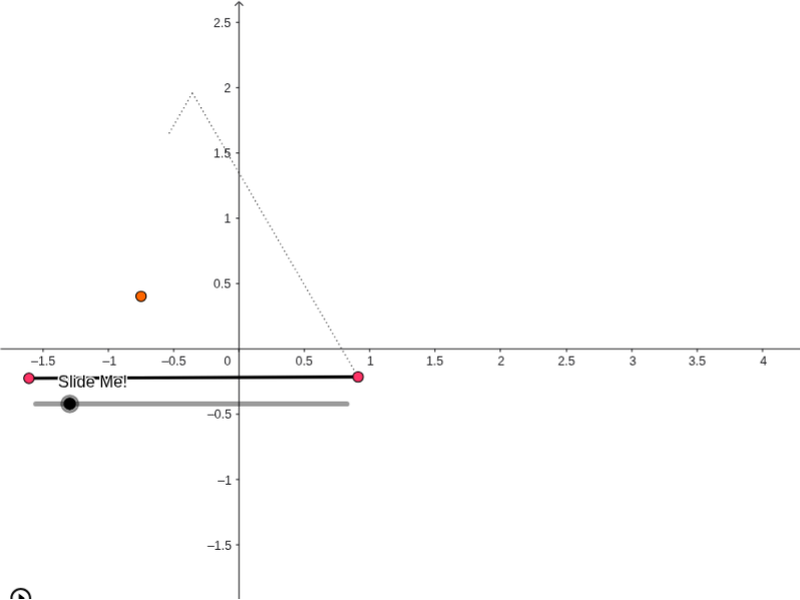
This example demonstrates the dynamic transformation of an equilateral triangle. Key mathematical concepts include the properties of equilateral triangles, reflection transformations, and exponential functions. Using GeoGebra commands such as Polygon, Dilate, Rotate, etc., the changes in the equilateral triangle under different transformations can be visually illustrated. Suitable for students at junior high school level and above to learn about geometric transformations and function applications.
GeoGebra Commands & Parameters
Polygon(A, B, 3) → poly1, a, b, c, CDilate(A, If[0 < d ≤ 1, 1 - d, 0], B) → A'Segment(A, A') → eDilate(B, If[1 < d ≤ 2, 2 - d, 0], C) → B'Segment(B, B') → fDilate(C, If[2 < d ≤ 3, 3 - d, 0], A) → C'Segment(C, C') → gSegment(A, B) → hSegment(A, C) → iSegment(B, C) → jCircle(A, (0.15 * h)) → kIntersect(k, i, 1) → DIntersect(k, h, 1) → ERotate(A, If[3.5 < d ≤ 4.5, ((d - 3.5) * π / 3), 1.0471975511965976], A) → A'_1Rotate(A', If[3.5 < d ≤ 4.5, ((d - 3.5) * π / 3), 1.0471975511965976], A) → A''Segment(A'_1, A'') → e'Rotate(A, If[4.5 < d ≤ 5.5, ((-(d - 4.5)) * π / 3), -1.0471975511965976], B) → A'_2Rotate(A', If[4.5 < d ≤ 5.5, ((-(d - 4.5)) * π / 3), -1.0471975511965976], B) → A''_1Segment(A'_2, A''_1) → e'_1Dilate(A, If[6 < d ≤ 7, 7 - d, 0], B) → A'_3Vector(A, A'_3) → uCircle(B, (0.15 * h)) → rIntersect(f, e'_1) → GIntersect(f, e'_1) → HIntersect(f, e'_1) → IIntersect(f, e'_1) → JIntersect(r, j, 1) → FIntersect(r, h, 1) → KDilate(B, If[8 < d ≤ 9, 9 - d, 0], C) → B'_1Vector(B, B'_1) → vIntersect(g, e') → LMidpoint(h) → OCircle(O, (0.05 * h)) → d_1Segment(C, O) → mIntersect(d_1, m, 1) → PIntersect(d_1, h) → Q, RCircleSector(O, R, P) → f_1Polygon(A, B, C) → poly2, c_2, a_1, b_1PointIn(poly2) → TOrthogonalLine(T, h) → nOrthogonalLine(T, i) → g_1OrthogonalLine(T, j) → h_1Intersect(g_1, i) → UIntersect(n, h) → VIntersect(h_1, j) → WAngle(T, U, C) → αAngle(T, V, A) → βAngle(T, W, B) → γCircle(W, (0.05 * h)) → qCircle(V, (0.05 * h)) → sCircle(U, (0.05 * h)) → tIntersect(q, j, 2) → ZIntersect(q, h_1, 2) → A_1Intersect(s, h, 2) → B_1Intersect(s, n, 2) → C_1Intersect(t, i, 1) → D_1Intersect(t, g_1, 1) → E_1CircleSector(W, Z, A_1) → k_1CircleSector(V, B_1, C_1) → p_1CircleSector(U, D_1, E_1) → q_1Dilate(T, If[10 < d ≤ 11, 11 - d, 0], U) → T'Segment(T, T') → i_1Segment(T, U) → j_1Segment(T, W) → l_1Segment(T, V) → m_1Circle(C, j_1) → c_1Segment(C, O) → e_1Intersect(c_1, e_1, 1) → MCircle(M, m_1) → s_1Intersect(s_1, e_1, 1) → NDilate(C, If[5.5 < d ≤ 6.5, 6.5 - d, 0], M) → C'_1Segment(C, C'_1) → lDilate(M, If[6.5 < d ≤ 7.5, 7.5 - d, 0], N) → M'Segment(M, M') → n_1Dilate(N, If[7.5 < d ≤ 8.5, 8.5 - d, 0], O) → N'Segment(N, N') → t_1Rotate(f_1, If[9 < d ≤ 10, ((d - 9) * π / 2), 1.5708], O) → pDilate(T, If[10 < d ≤ 11, 11 - d, 0], V) → T'_1Dilate(T, If[10 < d ≤ 11, 11 - d, 0], W) → T'_2Segment(T, T'_1) → a_2Segment(T, T'_2) → b_2Rotate(q_1, If[11.5 < d ≤ 12.5, ((d - 11.5) * π / 2), 1.5708], U) → r_1Rotate(p_1, If[11.5 < d ≤ 12.5, ((d - 11.5) * π / 2), 1.5708], V) → d_2Rotate(k_1, If[11.5 < d ≤ 12.5, ((d - 11.5) * π / 2), 1.5708], W) → e_2Dilate(U, If[13 < d ≤ 14, 14 - d, 0], C) → U'Vector(U, U') → wTranslate(T, w) → T'_3Translate(T', w) → T''Segment(T'_3, T'') → f_2Rotate(T'_3, If[14 < d ≤ 15, (((d - 14) * 2) * π / 3), 2.0943951023931953], M) → SRotate(T'', If[14 < d ≤ 15, (((d - 14) * 2) * π / 3), 2.0943951023931953], M) → T'''Rotate(T'_3, If[14 < d ≤ 15, d - 14 - π / 3, -1.0471975511965976], C) → F_1Rotate(T'', If[14 < d ≤ 15, d - 14 - π / 3, -1.0471975511965976], C) → T'''_1Rotate(T'_3, If[14 < d ≤ 15, ((-(d - 14)) * π / 3), -1.0472], C) → G_1Rotate(T'', If[14 < d ≤ 15, d - 14 - π / 3, -1.0471975511965976], C) → T'''_2Segment(G_1, T'''_2) → g_2Dilate(T, If[15 < d ≤ 16, 16 - d, 0], M) → T'_4Vector(T, T'_4) → u_1Translate(T, u_1) → T'_5Translate(T'_1, u_1) → H_1Segment(T'_5, H_1) → h_2Dilate(T, If[16 < d ≤ 17, 17 - d, 0], N) → T'_6Vector(T, T'_6) → v_1Translate(T, v_1) → T'_7Translate(T'_2, v_1) → I_1Segment(T'_7, I_1) → i_2Rotate(T'_7, If[17 < d ≤ 18, (((d - 17) * 4) * π / 3), 4.1887902047863905], N) → J_1Rotate(I_1, If[17 < d ≤ 18, (((-(d - 17)) * 2) * π / 3), -2.0943951023931953], N) → K_1Segment(J_1, K_1) → j_2Rotate(J_1, If[18 < d ≤ 19, (((-(d - 18)) * 5) * π / 3), -5.235987755982988], N) → L_1Rotate(L_1, If[20 < d ≤ 21, ((-(d - 20)) * π / 18), -0.17453292519943295], N) → N_1
AI Drawing Prompt Reference
Draw an equilateral triangle and dynamically transform it around a point. Start by drawing an equilateral triangle, then perform scaling transformations around its vertices, followed by translation transformations. Finally, use rotation and reflection transformations to further adjust the triangle's position and size.
The prompt above was compiled from the original drawing commands and is for reference only.