
Dynamic Relationships in a Cyclic Quadrilateral
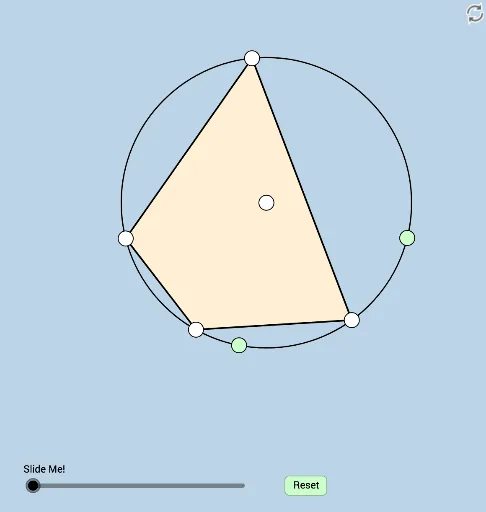
Loading the math board and drawing, please wait…
This example demonstrates dynamic and modifiable relationships within a cyclic quadrilateral, involving concepts like circles, rotations, dilations, and vectors. It uses commands such as Circle, Point, Rotate, CircleArc, Segment, Intersect, Dilate, Vector, Translate, Angle, Ray, Polygon, Line, OrthogonalLine, and LineBisector. Ideal for high school students and educators exploring geometric transformations and dynamic geometry.
GeoGebra Commands & Parameters
Circle(A_1, B_1) → cPoint(c) → C_1Rotate(C_1, 2°, A_1) → C'CircleArc(A_1, C', C_1) → dPoint(d) → DCircleArc(A_1, D, C_1) → ePoint(e) → CCircleArc(A_1, C, C_1) → fPoint(f) → BCircleArc(A_1, B, C_1) → gPoint(g) → ASegment(D, C) → bSegment(C, B) → hSegment(D, A) → aSegment(A, B) → iCircle(B, (0.2 * Distance[A_1, B_1])) → kCircle(C, (0.2 * Distance[A_1, B_1])) → pCircle(A, (0.2 * Distance[A_1, B_1])) → qCircle(D, (0.2 * Distance[A_1, B_1])) → rIntersect(k, i, 1) → H_1Intersect(k, h, 1) → IIntersect(p, h, 1) → JIntersect(p, b, 1) → KIntersect(r, a, 1) → LIntersect(r, b, 1) → MIntersect(q, a, 1) → NIntersect(q, i, 1) → OCircle(A_1, B_1) → e_1Dilate(C, If[0 < j ≤ 1, 1 - j, 0], A) → E'Vector(C, E') → uTranslate(J, u) → J'Angle(O, A, J') → αRay(D, A) → lPoint(l) → PDilate(B, If[2 < j ≤ 3, 3 - j, 0], D) → F'Vector(B, F') → vRay(A, D) → nPoint(n) → QTranslate(I, v) → I'Angle(I', D, M) → βPolygon(A, D, C, B) → poly1, g_2, d_2, e_2, f_2Line(C, D) → i_1OrthogonalLine(A, i_1) → j_1OrthogonalLine(B, i_1) → l_1Intersect(i_1, j_1) → EIntersect(i_1, l_1) → FLine(B, A) → m_1OrthogonalLine(D, m_1) → n_1OrthogonalLine(C, m_1) → p_1Intersect(p_1, m_1) → GIntersect(n_1, m_1) → HCircle(H, G, F) → q_1Dilate(A, If[0 < j ≤ 1, 1 - j, 0], E) → A'Dilate(D, If[0 < j ≤ 1, 1 - j, 0], E) → D'Segment(D, D') → sSegment(A, A') → tAngle(C, E, A) → γDilate(B, If[1 < j ≤ 2, 2 - j, 0], F) → B'Dilate(C, If[1 < j ≤ 2, 2 - j, 0], F) → C'_1Segment(C, C'_1) → f_1Segment(B, B') → g_1Angle(B, F, D) → δDilate(C, If[2 < j ≤ 3, 3 - j, 0], G) → C'_2Dilate(B, If[2 < j ≤ 3, 3 - j, 0], G) → B'_1Segment(C, C'_2) → mSegment(B, B'_1) → h_1Angle(A, G, C) → εDilate(D, If[3 < j ≤ 4, 4 - j, 0], H) → D'_1Dilate(A, If[3 < j ≤ 4, 4 - j, 0], H) → A'_1Segment(D, D'_1) → k_1Segment(A, A'_1) → r_1Angle(D, H, B) → ζLineBisector(G, F) → s_1LineBisector(E, H) → t_1Intersect(s_1, t_1) → RDilate(R, If[5 < j ≤ 6, 6 - j, 0], G) → R'Circle(R, R') → c_1Segment(R, R') → a_1Circle(C, U, B) → d_1Circle(A, V, D) → c_2LineBisector(C, U) → b_1LineBisector(U, B) → h_2Intersect(b_1, h_2) → WLineBisector(V, D) → i_2LineBisector(V, A) → j_2Intersect(j_2, i_2) → ZDilate(C, If[8 < j ≤ 9, 9 - j, 0], W) → C'_3Dilate(A, If[8 < j ≤ 9, 9 - j, 0], Z) → A'_2Segment(C, C'_3) → k_2Segment(A, A'_2) → l_2Rotate(C, If[9 < j ≤ 10, ((-(j - 9)) * π), (-π)], W) → C'_4Rotate(C'_3, If[9 < j ≤ 10, ((-(j - 9)) * π), (-π)], W) → D_1Segment(C'_4, D_1) → m_2Rotate(A, If[9 < j ≤ 10, ((-(j - 9)) * π), (-π)], Z) → A'_3Rotate(A'_2, If[9 < j ≤ 10, ((-(j - 9)) * π), (-π)], Z) → E_1Segment(A'_3, E_1) → n_2Dilate(W, If[10 < j ≤ 11, 11 - j, 0], U) → W'Dilate(Z, If[11 < j ≤ 12, 12 - j, 0], T) → Z'Circle(W, W') → p_2Segment(W, W') → q_2Segment(Z, Z') → r_2Circle(Z, Z') → s_2