
Dynamic Relationship of a Regular Pentagon and Its Circumcircle
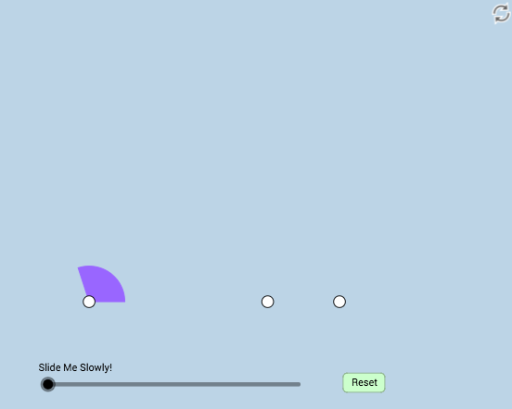
Loading the math board and drawing, please wait…
This example demonstrates the dynamic and modifiable relationship between a regular pentagon, its circumcircle, and several other segments. Key math concepts include polygons, circles, angles, vectors, and geometric transformations. The construction utilizes GeoGebra commands such as Rotate, Ray, Point, Segment, Circle, Intersect, Line, Angle, Min, CircleSector, Dilate, Vector, Translate, Polygon, LineBisector, OrthogonalLine, CircleArc, and Midpoint. It is suitable for high school and above students to explore complex geometric interactions and transformations.
GeoGebra Commands & Parameters
Rotate(A, 108°, B) → A'Ray(B, A') → gRay(B, A) → fPoint(f) → CSegment(C, B) → nCircle(C, n) → d_1Rotate(B, (-(108°)), C) → B'Ray(C, B') → hIntersect(d_1, h, 1) → G_1Circle(G_1, n) → e_1Point(h) → D_1Rotate(C, (-(108°)), D_1) → C'Ray(D_1, C') → iPoint(i) → ERotate(D_1, (-(108°)), E) → D'Ray(E, D') → jIntersect(g, j) → F_1Segment(F_1, E) → kSegment(E, D_1) → lLine(G_1, l) → g_1Intersect(e_1, g_1, 1) → JLine(J, k) → h_1Intersect(h_1, g) → KAngle(A, B, A') → αAngle(B', C, B) → βAngle(C', D_1, C) → γAngle(D', E, D_1) → δSegment(D_1, C) → mSegment(B, F_1) → pMin(list) → aCircle(B, (0.2 * n)) → qIntersect(q, p) → H,Intersect(q, n) → I,CircleSector(B, I, H) → rDilate(B, If[0 < o ≤ 1, 1 - o, 0], C) → B'_1Vector(B, B'_1) → uTranslate(r, u) → r'Rotate(r', If[1 < o ≤ 2, (((o - 1) * 2) * π / 5), (2 * π / 5)], C) → r''Dilate(C, If[2 < o ≤ 3, 3 - o, 0], G_1) → C'_1Vector(C, C'_1) → vTranslate(r'', v) → r'''Rotate(r''', If[3 < o ≤ 4, (((o - 3) * 2) * π / 5), (2 * π / 5)], G_1) → sDilate(G_1, If[4 < o ≤ 5, 5 - o, 0], J) → D'_1Vector(G_1, D'_1) → wTranslate(s, w) → s'Rotate(s', If[5 < o ≤ 6, (((o - 5) * 2) * π / 5), (2 * π / 5)], J) → s''Dilate(J, If[6 < o ≤ 7, 7 - o, 0], K) → E'Vector(J, E') → tTranslate(s'', t) → s'''Circle(J, n) → k_1Rotate(s''', If[7 < o ≤ 8, (((o - 7) * 2) * π / 5), (2 * π / 5)], K) → c_1Segment(B, B'_1) → bSegment(C, C'_1) → cSegment(G_1, D'_1) → dSegment(J, E') → eDilate(K, If[8 < o ≤ 9, 9 - o, 0], B) → K'Segment(K, K') → f_1Polygon(B, C, G_1, J, K) → poly1, b_1, c_2, g_2, j_1, k_2Rotate(B, If[9 < o ≤ 10, ((-(o - 9)) * α), (-α)], C) → B'_2Rotate(B'_1, If[9 < o ≤ 10, ((-(o - 9)) * α), (-α)], C) → LSegment(B'_2, L) → b'Rotate(B'_2, If[10 < o ≤ 11, ((-(o - 10)) * α), (-α)], G_1) → MRotate(L, If[10 < o ≤ 11, ((-(o - 10)) * α), (-α)], G_1) → L'Segment(M, L') → b''Rotate(M, If[11 < o ≤ 12, ((-(o - 11)) * α), (-α)], J) → M'Rotate(L', If[12 < o ≤ 13, ((-(o - 12)) * α), (-α)], J) → L''Segment(M', L'') → b'''Rotate(M', If[12 < o ≤ 13, ((-(o - 12)) * α), (-α)], K) → M''Rotate(L'', If[12 < o ≤ 13, ((-(o - 12)) * α), (-α)], K) → L'''Segment(M'', L''') → i_1LineBisector(B, C) → l_1LineBisector(G_1, J) → m_1Intersect(m_1, l_1) → NCircle(N, J) → p_1Intersect(p_1, m_1) → D, PLine(N, G_1) → n_1Line(J, G_1) → q_1Intersect(q_1, m_1) → FOrthogonalLine(F, n_1) → r_1Intersect(r_1, n_1) → GLine(J, D) → s_1Intersect(n_1, s_1) → OAngle(F, G, N) → εLine(N, G_1) → t_1Intersect(p_1, t_1) → Q, RRotate(J, If[13 < o ≤ 14, (((o - 13) * 288) * π / 180), (288 * π / 180)], N) → J'CircleArc(N, J, J') → d_2Rotate(G_1, If[14 < o ≤ 15, (((o - 14) * 36) * π / 180), (36 * π / 180)], N) → SCircleArc(N, G_1, S) → e_2Rotate(D, If[15 < o ≤ 16, (((o - 15) * 36) * π / 180), (36 * π / 180)], N) → D'_2CircleArc(N, D, D'_2) → f_2CircleArc(N, J, K) → h_2CircleArc(N, K, B) → p_2CircleArc(N, B, C) → q_2CircleArc(N, C, G_1) → r_2CircleArc(N, G_1, J) → s_2Rotate(e_2, If[18 < o ≤ 19, (((o - 18) * 36) * π / 180), (36 * π / 180)], N) → t_2Dilate(N, If[19 < o ≤ 20, 20 - o, 0], F) → N'Segment(N, N') → a_1Dilate(F, If[20 < o ≤ 21, 21 - o, 0], D) → F'Segment(F, F') → i_2Dilate(F, If[21 < o ≤ 22, 22 - o, 0], G) → F'_1Dilate(N, If[21 < o ≤ 22, 22 - o, 0], G) → N'_1Segment(N, N'_1) → j_2Segment(F, F'_1) → l_2Dilate(G, If[22 < o ≤ 23, 23 - o, 0], O) → G'Dilate(J, If[22 < o ≤ 23, 23 - o, 0], O) → J'_1Segment(J, J'_1) → m_2Segment(G, G') → n_2Dilate(N, If[22 < o ≤ 23, 23 - o, 0], Q) → N'_2Segment(N, N'_2) → a_2Midpoint(G, N) → TRotate(G, If[24.5 < o ≤ 25.5, ((-(o - 24.5)) * π), (-π)], T) → G'_1Rotate(G', If[24.5 < o ≤ 25.5, ((-(o - 24.5)) * π), (-π)], T) → G''Segment(G'_1, G'') → b_2