
Dynamic Relationship Between Angles in Tangent Circles
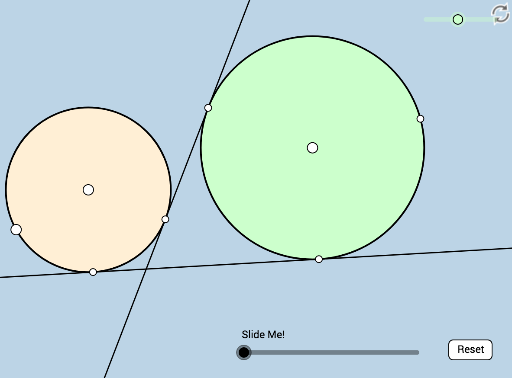
Loading the math board and drawing, please wait…
This example dynamically illustrates the relationship between two angles formed within the context of common internal and external tangents to circles. It involves core math concepts like circles, tangent lines, angles, vectors, and geometric transformations. Constructed using GeoGebra commands such as Circle, Segment, PointIn, Distance, Tangent, Intersect, Dilate, Angle, Line, Rotate, etc., it is suitable for high school and above students to explore geometric relationships and dynamic constructions.
GeoGebra Commands & Parameters
Circle(A, B) → cSegment(A, B) → fPointIn(a) → CDistance(C, c) → bCircle(C, d) → eTangent(c, e) → g, h, i, jIntersect(c, h) → DIntersect(c, j) → E, NIntersect(e, j) → FIntersect(e, h) → G, LIntersect(e, g) → H, KIntersect(e, i) → IIntersect(c, i) → J, MIntersect(c, g) → OCircle(D, 2) → pCircle(E, 2) → qCircle(O, 2) → rCircle(K, 2) → sCircle(I, 2) → tCircle(F, 2) → c_1Circle(G, 2) → d_1Circle(J, 2) → e_1Intersect(e_1, i, 1) → PIntersect(e_1, i, 2) → QIntersect(p, h, 1) → RIntersect(p, h, 2) → SIntersect(c_1, j, 2) → TIntersect(c_1, j, 1) → UIntersect(d_1, h, 1) → VIntersect(d_1, h, 2) → WIntersect(s, g, 2) → ZIntersect(s, g, 1) → A_1Intersect(r, g, 2) → B_1Intersect(r, g, 1) → C_1Intersect(q, j, 2) → D_1Intersect(q, j, 1) → E_1Dilate(A, If[0 < k ≤ 1, 1 - k, 0], D) → A'Dilate(A, If[0 < k ≤ 1, 1 - k, 0], M) → A'_1Dilate(A, If[0 < k ≤ 1, 1 - k, 0], E) → A'_2Dilate(A, If[0 < k ≤ 1, 1 - k, 0], O) → A'_3Angle(A, O, C_1) → αAngle(A, E, E_1) → βAngle(A, D, S) → δIntersect(t, i, 1) → F_1Angle(C, I, F_1) → ζAngle(C, G, W) → θ_1Dilate(C, If[0 < k ≤ 1, 1 - k, 0], G) → C'Dilate(C, If[0 < k ≤ 1, 1 - k, 0], F) → C'_1Dilate(C, If[0 < k ≤ 1, 1 - k, 0], I) → C'_2Dilate(C, If[0 < k ≤ 1, 1 - k, 0], K) → C'_3Intersect(i, j) → G_1Intersect(i, j) → H_1Line(C, H) → k_1Line(O, E) → l_1Intersect(e, ee) → J_1, , ,Intersect(e, l_1) → K_1, L_1Segment(H, K_1) → lSegment(C, L_1) → mMin(m, l) → nCircle(H, (0.3 * n)) → f_1Segment(C, F) → g_1Intersect(f_1, g) → I_1, M_1Intersect(f_1, l) → N_1,Line(F, C) → i_1Intersect(e, i_1) → O_1, P_1Angle(N_1, H, I_1) → εRotate(P_1, ε, C) → Q_1Angle(P_1, C, Q_1) → γDilate(F, If[0 < k ≤ 1, 1 - k, 0], C) → F'Segment(F, F') → h_1Dilate(C, If[1 < k ≤ 2, 2 - k, 0], P_1) → C'_4Segment(C, C'_4) → j_1Dilate(O, If[2 < k ≤ 3, 3 - k, 0], E) → O'Segment(O, O') → m_1Dilate(E, If[3 < k ≤ 4, 4 - k, 0], K_1) → E'Segment(E, E') → n_1Dilate(K_1, If[4 < k ≤ 5, 5 - k, 0], L_1) → R_1Segment(K_1, R_1) → p_1Dilate(H, If[5 < k ≤ 6, 6 - k, 0], K_1) → H'Segment(H, H') → q_1Line(O, K_1) → s_1Angle(P_1, C, L_1) → ηRotate(I_1, If[6 < k ≤ 7, ((-(k - 6)) * ε), (-ε)], H) → S_1CircleSector(H, S_1, I_1) → r_1Dilate(C, If[7 < k ≤ 8, 8 - k, 0], L_1) → C'_5Segment(C, C'_5) → t_1Dilate(H, If[8 < k ≤ 9, 9 - k, 0], C) → H'_1Vector(H, H'_1) → wTranslate(r_1, w) → c_2Line(H, j_1) → a_1Line(H, t_1) → b_1Point(b_1) → T_1Angle(I_1, H, T_1) → θRotate(c_2, If[9 < k ≤ 10, ((k - 9) * θ), θ], C) → d_2Dilate(C, If[10 < k ≤ 11, 11 - k, 0], Q_1) → C'_6Segment(C, C'_6) → f_2Dilate(H, If[11 < k ≤ 12, 12 - k, 0], C) → H'_2Vector(H, H'_2) → u_1Translate(r_1, u_1) → e_2Rotate(e_2, If[12 < k ≤ 13, ((k - 12) * (θ - ε)), θ - ε], C) → g_2Segment(A, B) → h_2