
Dynamic Logarithmic Action Demonstration
Loading the math board and drawing, please wait…
In collections
Exponential & Logarithmic Functions
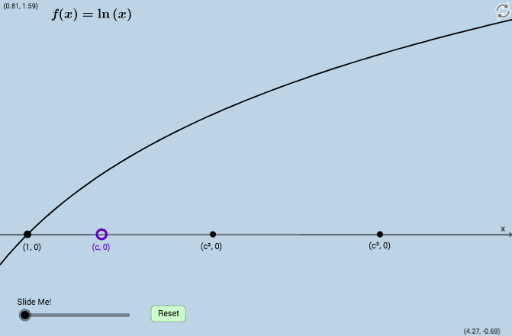
This example dynamically demonstrates the power property of logarithms, visually integrating logarithmic functions with geometric elements like polygons and vectors. Key math concepts include logarithmic functions, power operations, geometric transformations, and vector mathematics. It leverages GeoGebra commands such as Textfield, Intersect, Dilate, Segment, Vector, Translate, Rotate, Distance, Midpoint, Line, and Circle for dynamic graph generation and manipulation. Suitable for high school and above mathematics education to understand logarithmic properties and geometric applications.
GeoGebra Commands & Parameters
Textfield(a) → InputBox1Textfield(f_1) → InputBox2Textfield(f) → InputBox3Intersect(f, h, 1) → EDilate(F, If[0 < d ≤ 1, 1 - d, 0], A) → F'Dilate(A, If[1 < d ≤ 2, 2 - d, 0], B) → A'Segment(A, A') → jDilate(B, If[2 < d ≤ 3, 3 - d, 0], G) → B'Vector(B, B') → uTranslate(A, u) → A'_1Translate(A', u) → A''Segment(A'_1, A'') → j'Rotate(A'_1, If[3 < d ≤ 4, ((-(d - 3)) * π / 2), ((-π)) / 2], F) → HRotate(A'', If[3 < d ≤ 4, ((-(d - 3)) * π / 2), ((-π)) / 2], F) → A'''Segment(H, A''') → j''Rotate(A'_1, If[3 < d ≤ 4, ((d - 3) * π / 2), π / 2], F) → IRotate(A'', If[3 < d ≤ 4, ((d - 3) * π / 2), π / 2], F) → A'''_1Dilate(D, If[4 < d ≤ 5, 5 - d, 0], E) → D'Segment(D, D') → lDilate(A, If[1 < d ≤ 2, 2 - d, 0], C) → A'_2Segment(A, A'_2) → mDilate(A, If[2 < d ≤ 3, 3 - d, 0], R) → C'Vector(C, C') → vIntersect(f, p, 1) → NRotate(F, If[5 < d ≤ 6, ((d - 5) * π / 2), π / 2], F) → F'_1Rotate(F', If[5 < d ≤ 6, ((d - 5) * π / 2), π / 2], F) → F''Dilate(F, If[6 < d ≤ 7, 7 - d, 0], M) → F'_2Vector(F, F'_2) → wTranslate(F'_1, w) → PTranslate(F'', w) → F'''Distance(A, C) → distanceACVector(A, A'_2) → iVector(A, C') → b_1Midpoint(Z, A_1) → QLine(B_1, C_1) → eSegment(B_1, C_1) → g_1Circle(B_1, g_1 / 3) → c_1Intersect(c_1, e, 2) → TCircle(T, g_1 / 3) → d_1Intersect(d_1, e, 2) → UDilate(Z, If[2 < d ≤ 3, 3 - d, 0], Q) → Z'Segment(Z, Z') → qDilate(Q, If[3 < d ≤ 4, 4 - d, 0], A_1) → Q'Segment(Q, Q') → h_1Dilate(B_1, If[4 < d ≤ 5, 5 - d, 0], T) → D_1Segment(B_1, D_1) → i_1Dilate(T, If[5 < d ≤ 6, 6 - d, 0], U) → T'Segment(T, T') → j_1Dilate(U, If[6 < d ≤ 7, 7 - d, 0], C_1) → U'Segment(U, U') → k_1Segment(A, A'_2) → l_1Distance(Z, A_1) → distanceZA1Distance(B_1, C_1) → distanceB1C1Dilate(A, If[7 < d ≤ 8, 8 - d, 0], Z) → A'_3Vector(A, A'_3) → u_1Dilate(A, If[7 < d ≤ 8, 8 - d, 0], B_1) → A'_4Vector(A, A'_4) → v_1Translate(A, u_1) → A'_5Translate(A'_2, u_1) → LSegment(A'_5, L) → m_1Translate(A, v_1) → A'_6Translate(A'_2, v_1) → WSegment(A'_6, W) → n_1Rotate(A'_5, If[8 < d ≤ 9, ((d - 8) * π), π], Q) → E_1Rotate(L, If[8 < d ≤ 9, ((d - 8) * π), π], Q) → L'Segment(E_1, L') → p_1Rotate(A'_6, If[8 < d ≤ 9, ((d - 8) * π), π], T) → F_1Rotate(W, If[8 < d ≤ 9, ((d - 8) * π), π], T) → W'Segment(F_1, W') → q_1Rotate(F_1, If[9 < d ≤ 10, ((d - 9) * π), π], U) → G_1Rotate(W', If[9 < d ≤ 10, ((d - 9) * π), π], U) → W''Segment(G_1, W'') → r_1