
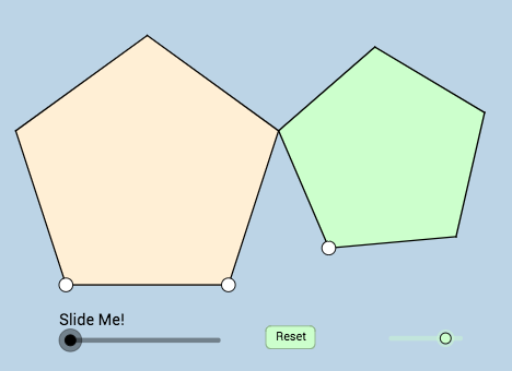
Dynamic Illustration of Two Regular Pentagons Sharing a Vertex
Loading the math board and drawing, please wait…
This GeoGebra applet dynamically illustrates the geometric relationship between two regular pentagons sharing a common vertex. Key mathematical concepts include regular polygon properties, rotational symmetry, and angle-segment relationships. Construction utilizes commands such as Polygon, Rotate, Intersect, Angle, Vector, and Translate to create an interactive model. Suitable for high school geometry instruction or independent exploration of Euclidean geometry properties by math enthusiasts.
GeoGebra Commands & Parameters
Polygon(A, B, 5) → poly1, f, g, h, i, j, C, D, ERotate(B, 144°, C) → B'Ray(C, B') → sLine(B, C) → kCircle(C, a) → cIntersect(c, s) → N,Intersect(c, k) → F, GCircleArc(C, F, N) → eLine(C, D) → lIntersect(c, l) → H, ICircleArc(C, F, I) → dPoint(e) → JPolygon(C, J, 5) → poly2, m, n, p, q, r, K, L, MAngle(B, C, B') → αSegment(D, A) → tSegment(D, B) → bLineBisector(D, C) → f_1LineBisector(B, C) → g_1LineBisector(M, L) → h_1LineBisector(L, K) → i_1Segment(M, J) → j_1Segment(E, K) → k_1Segment(A, L) → l_1Intersect(k_1, l_1) → QCircle(D, (0.2 * j_1)) → c_1Segment(D, E) → m_1Intersect(c_1, t, 1) → RIntersect(i, m_1) → SIntersect(c_1, m_1) → T,CircleSector(D, T, R) → d_1Dilate(E, If[0 < o ≤ 1, 1 - o, 0], K) → E'Segment(E, E') → n_1Dilate(A, If[1 < o ≤ 2, 2 - o, 0], Q) → A'Segment(A, A') → p_1Dilate(Q, If[2 < o ≤ 3, 3 - o, 0], L) → Q'Segment(Q, Q') → q_1Dilate(D, If[3 < o ≤ 4, 4 - o, 0], A) → D'Dilate(D, If[3 < o ≤ 4, 4 - o, 0], B) → D'_1Segment(D, D') → r_1Segment(D, D'_1) → s_1Rotate(d_1, If[5 < o ≤ 6, (((o - 5) * 36) * π / 180), (36 * π / 180)], D) → e_1Rotate(e_1, If[7 < o ≤ 8, (((o - 7) * 36) * π / 180), (36 * π / 180)], D) → t_1Line(Q, s_1) → a_1Dilate(D, If[9 < o ≤ 10, 10 - o, 0], Q) → D'_2Vector(D, D'_2) → uTranslate(t_1, u) → c_2Segment(D, E) → b_1Segment(E, A) → f_2Segment(A, B) → g_2Segment(B, C) → h_2Segment(C, D) → i_2Segment(C, M) → j_2Segment(M, L) → k_2Segment(L, K) → l_2Segment(K, J) → m_2Segment(J, C) → n_2Point(a_1) → OAngle(O, Q, K) → βRotate(c_2, If[10 < o ≤ 11, ((o - 10) * β), β], Q) → d_2