
Dynamic Illustration of External and Internal Tangent Segments
Loading the math board and drawing, please wait…
In collections
Circles (Theorems)
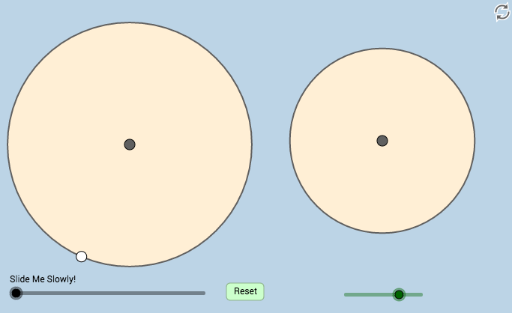
This example dynamically illustrates the relationship between segments created from external and internal tangents of two circles. It involves the geometric properties of circles and the comparison of segment lengths. Using GeoGebra commands such as Circle, Tangent, and Intersect, one can observe the changes in segment lengths under different conditions. Suitable for middle school and above students or teachers for teaching and learning.
GeoGebra Commands & Parameters
Circle(A, B) → cSegment(A, B) → fPointIn(a) → CDistance(C, c) → bCircle(C, d) → eTangent(c, e) → g, h, i, jIntersect(c, h) → DIntersect(c, j) → E, NIntersect(e, j) → FIntersect(e, h) → G, LIntersect(e, g) → H, KIntersect(e, i) → IIntersect(c, i) → J, MIntersect(c, g) → OCircle(D, 2) → pCircle(E, 2) → qCircle(O, 2) → rCircle(K, 2) → sCircle(I, 2) → tCircle(F, 2) → c_1Circle(G, 2) → d_1Circle(J, 2) → e_1Intersect(e_1, i, 1) → PIntersect(e_1, i, 2) → QIntersect(p, h, 1) → RIntersect(p, h, 2) → SIntersect(c_1, j, 2) → TIntersect(c_1, j, 1) → UIntersect(d_1, h, 1) → VIntersect(d_1, h, 2) → WIntersect(s, g, 2) → ZIntersect(s, g, 1) → A_1Intersect(r, g, 2) → B_1Intersect(r, g, 1) → C_1Intersect(q, j, 2) → D_1Intersect(q, j, 1) → E_1Dilate(A, If[0 < k ≤ 1, 1 - k, 0], D) → A'Dilate(A, If[4 < k ≤ 5, 5 - k, 0], M) → A'_1Dilate(A, If[9 < k ≤ 10, 10 - k, 0], E) → A'_2Dilate(A, If[0 < k ≤ 1, 1 - k, 0], O) → A'_3Angle(A, O, C_1) → αAngle(A, E, E_1) → βAngle(A, J, Q) → γAngle(A, D, S) → δAngle(C, K, A_1) → εIntersect(t, i, 1) → F_1Angle(C, I, F_1) → ζAngle(C, F, T) → ηAngle(C, G, W) → θDilate(C, If[0 < k ≤ 1, 1 - k, 0], G) → C'Dilate(C, If[9 < k ≤ 10, 10 - k, 0], F) → C'_1Dilate(C, If[4 < k ≤ 5, 5 - k, 0], I) → C'_2Dilate(C, If[0 < k ≤ 1, 1 - k, 0], K) → C'_3Segment(A, A') → lSegment(A, A'_1) → mSegment(A, A'_2) → nSegment(A, A'_3) → f_1Segment(C, C') → g_1Segment(C, C'_1) → h_1Segment(C, C'_2) → i_1Segment(C, C'_3) → j_1Intersect(i, j) → G_1Intersect(i, j) → H_1Intersect(h, i) → I_1Intersect(g, j) → J_1Intersect(g, i) → K_1Intersect(h, j) → L_1Segment(I_1, M) → k_1Segment(M, I) → l_1Segment(I, K_1) → m_1Segment(J_1, E) → n_1Segment(E, F) → p_1Segment(F, L_1) → q_1Dilate(K_1, If[1 < k ≤ 2, 2 - k, 0], M) → M_1Dilate(M, If[2 < k ≤ 3, 3 - k, 0], I) → M'Dilate(I, If[3 < k ≤ 4, 4 - k, 0], I_1) → I'Segment(K_1, M_1) → r_1Segment(M, M') → s_1Segment(I, I') → t_1Midpoint(M, I) → N_1Rotate(K_1, If[5 < k ≤ 6, ((k - 5) * π), π], N_1) → O_1Rotate(M_1, If[5 < k ≤ 6, ((k - 5) * π), π], N_1) → P_1Segment(O_1, P_1) → a_1Dilate(J_1, If[6 < k ≤ 7, 7 - k, 0], F) → Q_1Dilate(F, If[7 < k ≤ 8, 8 - k, 0], E) → F'Dilate(E, If[8 < k ≤ 9, 9 - k, 0], L_1) → E'Segment(J_1, Q_1) → b_1Segment(F, F') → f_2Segment(E, E') → g_2Midpoint(Q_1, E) → R_1Rotate(J_1, If[10 < k ≤ 11, ((k - 10) * π), π], R_1) → S_1Rotate(Q_1, If[10 < k ≤ 11, ((k - 10) * π), π], R_1) → T_1Segment(S_1, T_1) → h_2