
Dynamic Illustration of an Equilateral Triangle Problem
Loading the math board and drawing, please wait…
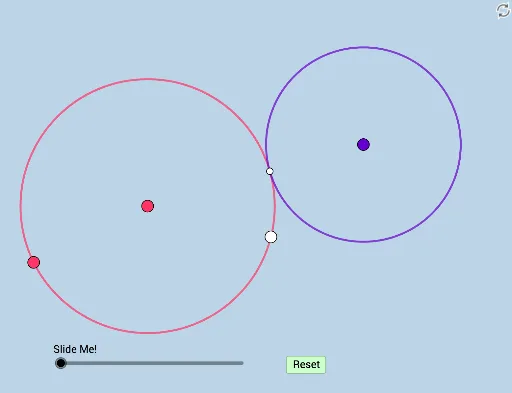
This is a dynamic and modifiable illustration of an equilateral triangle problem posted by Antonio Gutierrez on Twitter. The example demonstrates the basic properties and dynamic transformations of an equilateral triangle. Using GeoGebra commands such as Distance, PointIn, Line, Circle, Intersect, Rotate, CircleArc, OrthogonalLine, Point, Polygon, Semicircle, Segment, Angle, Dilate, Vector, Translate, one can observe the properties and transformations of the equilateral triangle. Suitable for students at the junior high school level and above to learn about geometric transformations and dynamic geometry.
GeoGebra Commands & Parameters
Distance(A, B) → aPointIn(b) → CLine(C, A) → fCircle(A, B) → cIntersect(c, f) → D, ERotate(D, (-2 * π / 3), A) → D'Rotate(D', (-2 * π / 3), A) → D''CircleArc(A, D'', D') → qOrthogonalLine(D, f) → gPoint(q) → FRotate(F, (2 * π / 3), A) → F'Rotate(F', (2 * π / 3), A) → F''Polygon(F, F', F'') → t1, f'', f_1, f'Semicircle(C, F') → eSemicircle(F'', C) → hIntersect(d, e, 1) → IIntersect(d, h, 1) → JSegment(F', I) → iSegment(F'', J) → jSemicircle(F, C) → kIntersect(d, k, 1) → KSegment(F, K) → lAngle(F'', J, C) → αAngle(C, I, F') → βAngle(F, K, C) → γCircle(F, i) → pIntersect(p, l, 1) → GDilate(F, If[0 < n ≤ 1, 1 - n, 0], F') → F'_1Segment(F, F'_1) → rRotate(F, If[1 < n ≤ 2, ((n - 1) * π / 3), π / 3], F) → F'_2Rotate(F'_1, If[1 < n ≤ 2, ((n - 1) * π / 3), π / 3], F) → HSegment(F'_2, H) → r'Rotate(F, If[2 < n ≤ 3, ((-(n - 2)) * π / 3), ((-π)) / 3], F') → F'_3Rotate(F'_1, If[2 < n ≤ 3, ((-(n - 2)) * π / 3), ((-π)) / 3], F') → LSegment(F'_3, L) → r'_1Dilate(C, If[3 < n ≤ 4, 4 - n, 0], I) → C'Dilate(F', If[3 < n ≤ 4, 4 - n, 0], I) → F''_1Segment(F', F''_1) → sSegment(C, C') → tDilate(F'', If[4 < n ≤ 5, 5 - n, 0], J) → F'''Segment(F'', F''') → g_1Dilate(C, If[4 < n ≤ 5, 5 - n, 0], J) → C'_1Segment(C, C'_1) → h_1Dilate(F, If[5 < n ≤ 6, 6 - n, 0], G) → F'_4Segment(F, F'_4) → i_1Dilate(G, If[6 < n ≤ 7, 7 - n, 0], K) → G'Segment(G, G') → j_1Dilate(C, If[6 < n ≤ 7, 7 - n, 0], K) → C'_2Segment(C, C'_2) → k_1Dilate(F', If[8 < n ≤ 9, 9 - n, 0], F) → F''_2Vector(F', F''_2) → uTranslate(F', u) → F''_3Translate(F''_1, u) → MSegment(F''_3, M) → s'Line(F', j_1) → l_1Point(l_1) → NAngle(I, F', N) → δRotate(F''_3, If[9 < n ≤ 10, ((n - 9) * δ), δ], F) → ORotate(M, If[9 < n ≤ 10, ((n - 9) * δ), δ], F) → M'Segment(O, M') → s''Dilate(J, If[10 < n ≤ 11, 11 - n, 0], K) → J'Vector(J, J') → vTranslate(F'', v) → F'''_1Translate(F''', v) → PSegment(F'''_1, P) → m_1Line(J, j_1) → n_1Point(n_1) → QAngle(F'', J, Q) → εRotate(F'''_1, If[11 < n ≤ 12, ((n - 11) * ε), ε], K) → RRotate(P, If[11 < n ≤ 12, ((n - 11) * ε), ε], K) → P'Segment(R, P') → p_1