
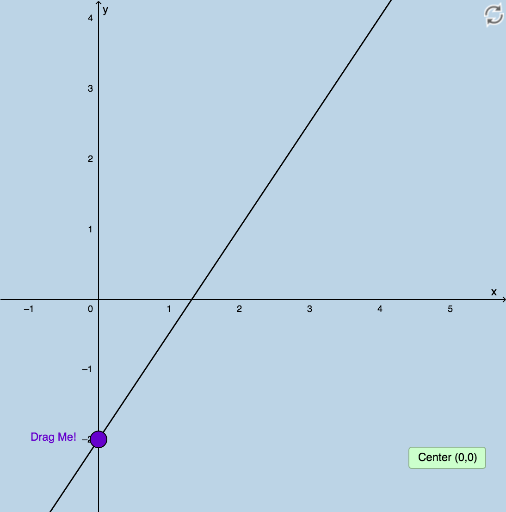
Dynamic Illustration of a Line Equation
Loading the math board and drawing, please wait…
In collections
A1.ACE.1 - Create and solve equations and inequalities
Graphing Linear Equations
Graphing Linear Equations
Graphing Linear Equations
Graphing Linear Equations
This example dynamically illustrates the equation of a non-vertical line. Key mathematical concepts include line equations and vectors. Using GeoGebra commands such as Vector, Translate, and Dilate, the transformation of lines through translation and scaling can be visually understood. Suitable for students in middle school and above studying coordinate geometry and line equations.
GeoGebra Commands & Parameters
Vector((0, 0), (1, 0)) → uTranslate(A, u) → A'Dilate(A, If[0 < o ≤ 1, 1 - o, 0], A') → A'_1Dilate(A'_1, If[1 < o ≤ 2, 2 - o, 0], B) → HDilate((0, 0), If[-1 < o ≤ 0, (-o), 0], A) → D_1Translate(G, u) → G'Translate(B, u) → B'Translate(C, u) → C'Translate(D, u) → D'Polygon(A, A', B) → poly1, b, a_1, a'Polygon(B, B', C) → poly2, c, b_1, b'Polygon(C, C', D) → poly3, d, c_1, c'Polygon(D, D', E) → poly4, e, d_1, d'Dilate(B, If[0 < o ≤ 1, 1 - o, 0], B') → B'_1Dilate(C, If[0 < o ≤ 1, 1 - o, 0], C') → C'_1Dilate(D, If[0 < o ≤ 1, 1 - o, 0], D') → D'_1Segment(A, A'_1) → pSegment(B, B'_1) → qSegment(C, C'_1) → rSegment(D, D'_1) → sDilate(A'_1, If[2 < o ≤ 3, 3 - o, 0], B'_1) → IVector(A'_1, I) → vTranslate(A'_1, v) → JTranslate(H, v) → H'Dilate(B'_1, If[3 < o ≤ 4, 4 - o, 0], C'_1) → KVector(B'_1, K) → wTranslate(J, w) → J'Translate(H', w) → H''Dilate(C'_1, If[4 < o ≤ 5, 5 - o, 0], D'_1) → MVector(C'_1, M) → u_1Translate(J', u_1) → J''Translate(H'', u_1) → H'''Translate(L, u) → L'Translate(F, u) → F'Line(A, B) → f_1IntegralBetween(f, g, 0, 1) → e_1Translate(O, u) → O'IntegralBetween(f, g_1, 1, 2) → h_1IntegralBetween(f, h, 2, 3) → i_1Dilate(O, If[0 < p_1 ≤ 1, 1 - p_1, 0], O') → O'_1Dilate(L, If[0 < p_1 ≤ 1, 1 - p_1, 0], L') → L'_1Dilate(G, If[0 < p_1 ≤ 1, 1 - p_1, 0], G') → G'_1Segment(G, G'_1) → k_1Segment(O, O'_1) → l_1Segment(L, L'_1) → m_1Dilate(G'_1, If[1 < p_1 ≤ 2, 2 - p_1, 0], O) → PSegment(G'_1, P) → q_1Midpoint(O'_1, L) → QMidpoint(L'_1, F) → RDilate(G'_1, If[2 < p_1 ≤ 3, 3 - p_1, 0], O'_1) → SVector(G'_1, S) → v_1Translate(G'_1, v_1) → TTranslate(P, v_1) → P'Segment(T, P') → j_1Dilate(G'_1, If[3 < p_1 ≤ 4, 4 - p_1, 0], Q) → UVector(G'_1, U) → w_1Translate(G'_1, w_1) → VTranslate(P, w_1) → P'_1Segment(V, P'_1) → n_1Segment(O'_1, L) → r_1Dilate(O'_1, If[4 < p_1 ≤ 5, 5 - p_1, 0], L'_1) → WVector(O'_1, W) → s_1Translate(O'_1, s_1) → ZTranslate(L, s_1) → L'_2Segment(Z, L'_2) → t_1Dilate(O'_1, If[5 < p_1 ≤ 6, 6 - p_1, 0], R) → A_1Vector(O'_1, A_1) → u_2Translate(O'_1, u_2) → B_1Translate(L, u_2) → L'_3Segment(B_1, L'_3) → f_2Segment(C_1, A) → g_2Slope(f_1) → a_2Textfield(m) → InputBox1Distance(C_1, A) → distanceC1ADistance(A'_1, H) → c_2Vector(E_1, D_1) → v_2Vector(A'_1, H) → tDistance(E_1, D_1) → distanceE1D1Vector(J, H') → w_2Vector(J', H'') → c_2Vector(J'', H''') → d_2Distance(J, C) → distanceJCDistance(J', D) → distanceJ'DDistance(J'', E) → distanceJ''E