
Dynamic Illustration of a Chord & Tangent Theorem
Loading the math board and drawing, please wait…
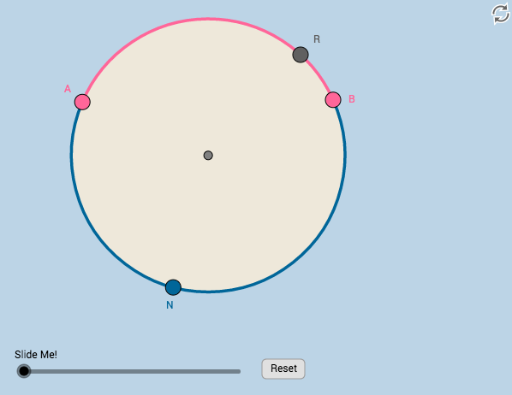
This example dynamically illustrates a less commonly discussed theorem that relates both chords and tangents. The math concepts involved include circle, angle, congruence, rotation, similarity, and more. It is constructed using GeoGebra commands and objects such as Circle, Point, Tangent, Segment, Angle, Rotate, CircleArc, Intersect, CircleSector, Dilate, Ray, and Distance. Suitable for high school and above students to visually understand complex geometric theorems and their proofs.
GeoGebra Commands & Parameters
Circle(A_1, R) → cPoint(c) → BPoint(c) → ATangent(A, c) → j,Segment(A, B) → hAngle(B, A_1, A) → αRotate(B, α / 2, A_1) → D'CircleArc(A_1, A, B) → ePoint(e) → NTangent(N, c) → g,Intersect(g, j) → FSegment(D', F) → kIntersect(h, k) → PCircle(P, A) → p_2Intersect(p_2, h) → V, WSegment(A_1, R) → fCircleArc(A_1, B, A) → dAngle(B, A_1, D') → βTangent(B, c) → i,Intersect(g, i) → GSegment(D', G) → lIntersect(h, l) → QSegment(A, P) → mSegment(P, Q) → nSegment(Q, B) → pSegment(A_1, B) → qSegment(A_1, D') → rSegment(A_1, A) → sCircle(A_1, (0.2 * r)) → tIntersect(t, q, 1) → JIntersect(t, r, 1) → KCircleSector(A_1, J, K) → c_1Dilate(A_1, If[0 < b ≤ 1, 1 - b, 0], A) → A'Dilate(A_1, If[0 < b ≤ 1, 1 - b, 0], B) → J'Segment(A_1, J') → f_1Segment(A_1, A') → g_1Dilate(A_1, If[6 < b ≤ 7, 7 - b, 0], D') → A'_1Segment(A_1, A'_1) → h_1Circle(B, (0.2 * r)) → e_1Circle(A, (0.2 * r)) → k_1Intersect(k_1, j) → L, MIntersect(k_1, g_1) → N_1,Intersect(e_1, i) → O, P_1Intersect(e_1, f_1) → Q_1,CircleSector(A, N_1, M) → p_1CircleSector(B, O, Q_1) → q_1Rotate(q_1, If[1.5 < b ≤ 2.5, ((b - 1.5) * π / 2), π / 2], B) → s_1Dilate(A_1, If[3.5 < b ≤ 4.5, 4.5 - b, 0], N) → A'_2Segment(A_1, A'_2) → i_1Circle(N, (0.2 * r)) → t_1Intersect(t_1, g, 1) → R_1Intersect(t_1, i_1, 1) → SCircleSector(N, R_1, S) → c_2Dilate(N, If[2.5 < b ≤ 3.5, 3.5 - b, 0], G) → C'Dilate(N, If[2.5 < b ≤ 3.5, 3.5 - b, 0], F) → C'_1Segment(N, C') → j_1Segment(N, C'_1) → l_1Rotate(c_2, If[5 < b ≤ 6, ((b - 5) * π / 2), π / 2], N) → d_2Rotate(c_1, If[7.5 < b ≤ 8.5, ((b - 7.5) * β), β], A_1) → d_1Ray(B, O) → m_1Circle(G, 1) → e_2Intersect(e_2, i, 2) → TCircle(F, 1) → f_2Intersect(f_2, j, 1) → URay(A, M) → n_1Ray(F, U) → a_1Ray(G, T) → b_1Segment(B, G) → g_2Segment(A, F) → h_2Rotate(p_1, If[1.5 < b ≤ 2.5, ((-(b - 1.5)) * π / 2), ((-π)) / 2], A) → r_1Dilate(F, If[8.5 < b ≤ 9.5, 9.5 - b, 0], D') → D''Segment(D', D'') → i_2Dilate(G, If[9.5 < b ≤ 10.5, 10.5 - b, 0], D') → D''_1Segment(D', D''_1) → j_2Distance(D', P) → oDistance(D', F) → uDistance(D', Q) → wDistance(D', G) → o_1Dilate(A, If[10.5 < b ≤ 11.5, 11.5 - b, 0], P) → E'Segment(A, E') → k_2Dilate(P, If[11.5 < b ≤ 12.5, 12.5 - b, 0], W) → H'Segment(P, H') → l_2Dilate(Q, If[13.5 < b ≤ 14.5, 14.5 - b, 0], B) → I'Segment(Q, I') → m_2Dilate(W, If[12.5 < b ≤ 13.5, 13.5 - b, 0], Q) → W'Segment(W, W') → n_2Rotate(A, If[15 < b ≤ 16, ((b - 15) * π), π], P) → E'_1Rotate(E', If[15 < b ≤ 16, ((b - 15) * π), π], P) → E''Segment(E'_1, E'') → q_2Rotate(Q, If[16 < b ≤ 17, ((-(b - 16)) * π), (-π)], Q) → I'_1Rotate(I', If[16 < b ≤ 17, ((-(b - 16)) * π), (-π)], Q) → I''Segment(I'_1, I'') → r_2Segment(F, D'') → s_2Segment(G, D''_1) → t_2