
Dynamic Geometry Problem Demonstration
Loading the math board and drawing, please wait…
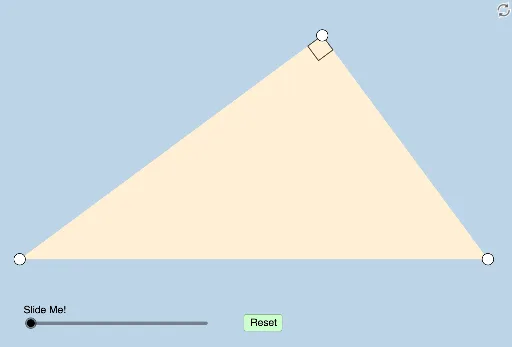
This example dynamically demonstrates a geometry problem posted by Antonio Gutierrez on Twitter. It involves core mathematical concepts such as special points, quadratic equations, and polygons. Key construction points include using GeoGebra commands and objects like Circle, Ray, Point, Semicircle, Segment, Polygon, Midpoint, Angle, OrthogonalLine, Intersect, Rotate, Line, Distance, Dilate, Min, and CircleSector. Suitable for high school and above, for learning and exploring geometric problems.
GeoGebra Commands & Parameters
Circle(A, B) → cRay(A, B) → fPoint(f) → CSemicircle(A, C) → dPoint(d) → DSegment(A, D) → gSegment(D, C) → hSegment(C, A) → iPolygon(A, C, D) → t1, d_1, a, c_1Midpoint(A, C) → EAngle(A, D, C) → αOrthogonalLine(D, i) → jIntersect(j, i) → FAngle(D, F, A) → βSegment(D, F) → kAngle(D, C, F) → γAngle(F, A, D) → δRotate(F, δ / 2, A) → F'Angle(F, A, F') → εRotate(D, γ / 2, C) → D'Angle(D, C, D') → ζRay(A, F') → lRay(C, D') → mRotate(D, π / 4, F) → D'_1Angle(D, F, D'_1) → ηRay(F, D'_1) → nRotate(C, π / 4, F) → C'Angle(C, F, C') → θRay(F, C') → pIntersect(l, n) → GIntersect(m, p) → HOrthogonalLine(G, g) → qIntersect(g, q) → IOrthogonalLine(H, i) → rIntersect(i, xAxis) → JIntersect(r, i) → KLine(D, C) → sRay(G, H) → tIntersect(s, t) → LDistance(G, L) → distanceGLDistance(F, D) → distanceFDDistance(D, L) → distanceDLDistance(D, F) → distanceDFDilate(D, If[0 < b ≤ 1, 1 - b, 0], F) → D'_2Segment(D, D'_2) → eDilate(F, If[1 < b ≤ 2, 2 - b, 0], H) → F'_1Dilate(C, If[1 < b ≤ 2, 2 - b, 0], H) → C'_1Segment(F, F'_1) → f_1Segment(C, C'_1) → g_1Segment(C, L) → h_1Segment(F, K) → i_1Intersect(t, e) → MSegment(F, M) → j_1Segment(F, A) → k_1Segment(A, I) → l_1Min({h_1, i_1, j_1, k_1, l_1}) → oCircle(C, (0.7 * o)) → e_1Circle(F, (0.7 * o)) → p_1Circle(A, (0.7 * o)) → q_1Intersect(i, xAxis) → NIntersect(i, xAxis) → OIntersect(i, xAxis) → PIntersect(q_1, i) → Q,Intersect(p_1, i) → R, SIntersect(p_1, e_1) → T, , ,Intersect(e_1, s) → U, VRotate(U, If[2 < b ≤ 3, ((b - 2) * ζ), ζ], C) → U'Rotate(R, If[2 < b ≤ 3, ((b - 2) * π / 4), π / 4], F) → R'CircleSector(C, U, U') → r_1CircleSector(F, R, R') → s_1Rotate(r_1, If[4 < b ≤ 5, ((b - 4) * ζ), ζ], C) → t_1Rotate(s_1, If[4 < b ≤ 5, ((b - 4) * π / 4), π / 4], F) → c_2Dilate(A, If[5 < b ≤ 6, 6 - b, 0], G) → A'Dilate(F, If[5 < b ≤ 6, 6 - b, 0], G) → F'_2Segment(A, A') → m_1Segment(F, F'_2) → n_1Rotate(Q, If[6 < b ≤ 7, ((b - 6) * ε), ε], A) → Q'CircleSector(A, Q, Q') → d_2Rotate(d_2, If[8 < b ≤ 9, ((b - 8) * ε), ε], A) → e_2Rotate(c_2, If[8 < b ≤ 9, ((b - 8) * π / 4), π / 4], F) → f_2Dilate(G, If[9 < b ≤ 10, 10 - b, 0], H) → G'Segment(G, G') → a_1Dilate(H, If[10 < b ≤ 11, 11 - b, 0], L) → H'Segment(H, H') → b_1Dilate(D, If[11 < b ≤ 12, 12 - b, 0], L) → D'_3Segment(D, D'_3) → g_2Angle(F, D, C) → ρRotate(D, If[13 < b ≤ 14, ((b - 13) * ρ), ρ], D) → D'_4Rotate(D'_2, If[13 < b ≤ 14, ((b - 13) * ρ), ρ], D) → WSegment(D'_4, W) → e'