
Applying the Angle Addition Postulate
Loading the math board and drawing, please wait…
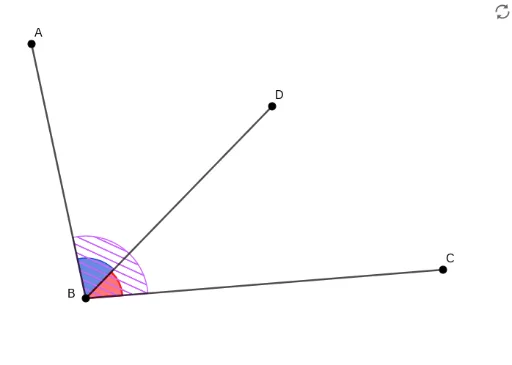
This example demonstrates how to use the Angle Addition Postulate to analyze and calculate the sum of interior angles in polygons. Key math concepts involved include angle measurement, polygon properties, and applications of coordinate geometry. Construction highlights involve using GeoGebra commands like Segment, Angle, and labeling key points A, B, C, D and angles α, β, γ. Suitable for middle school and above students to understand and practice the Angle Addition Postulate and its applications in geometric problems.
GeoGebra Commands & Parameters
Segment(A, B) → fSegment(B, C) → gSegment(B, D) → hAngle(D, B, A) → αAngle(C, B, D) → βAngle(C, B, A) → γ
AI Drawing Prompt Reference
Draw a quadrilateral ABCD, connect points A and B, B and C, B and D. Measure angles DBA, CBD, and CBA, and label them as α, β, and γ respectively. Use the angle addition postulate to analyze the sum of these angles.
The prompt above was compiled from the original drawing commands and is for reference only.