
Kite and Trapezium: Quadrilateral Classification and Construction
Loading the math board and drawing, please wait…
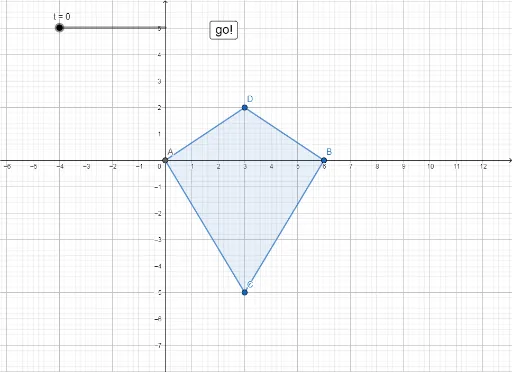
① This example demonstrates the geometric relationships and construction of two special quadrilaterals: a kite and a trapezium, showing their side and angle characteristics interactively. ② Core mathematical concepts include quadrilateral classification (kite, trapezium, parallelogram), conditions for parallel opposite sides and equal adjacent sides, and the use of trigonometric functions in angle calculations, along with rational number ratios. ③ Construction details: using GeoGebra commands Intersect to find intersection points, Point to define vertices A, B, C, D, Polygon to form quadrilateral t, with segments a, b, c, d and a button1 to control dynamic display, possibly toggling between states. ④ Suitable for middle and high school students learning plane geometry and quadrilateral properties, and for teachers demonstrating in class to help students visually distinguish definitions and criteria of different quadrilaterals, while understanding logical steps in geometric construction.
GeoGebra Commands & Parameters
Intersect(xAxis, yAxis) → APoint(xAxis) → BPolygon(A, C, B, D) → q1, a, c, b, d
AI Drawing Prompt Reference
Draw a quadrilateral classification example including a kite and a trapezium to demonstrate their side and angle characteristics. Start by finding the intersection of the coordinate axes as one vertex, then define another vertex on the x-axis. Construct a quadrilateral using these vertices and label its sides. Use a dynamic button to toggle between the kite and trapezium states, allowing observation of their geometric relationships and construction steps.
The prompt above was compiled from the original drawing commands and is for reference only.