
Dynamic Geometry Illustration of a Theorem with Square, Circles, and Tangent Cir
Loading the math board and drawing, please wait…
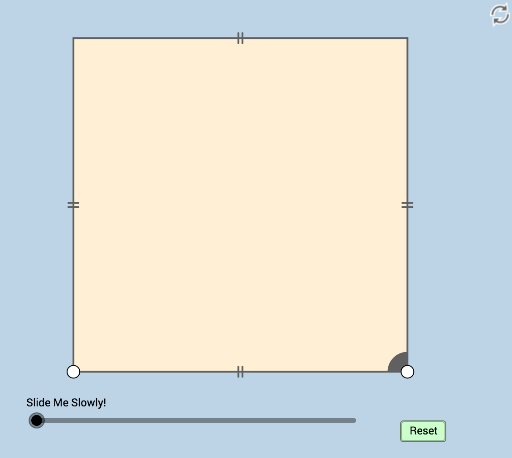
This example dynamically illustrates a theorem involving a square, two circles, and a mutually tangent circle. Key math concepts include circles, squares, geometric mean, vectors, and geometric transformations. Construction highlights the use of commands like Circle, Rotate, Dilate, Segment, Polygon, Point, OrthogonalLine, Intersect, Line, Radius, CircleSector, Vector, Translate, CircleArc, and Midpoint. Suitable for high school mathematics students and teachers to explore geometric theorems and transformations.
GeoGebra Commands & Parameters
Circle(A, B) → e_1Rotate(A, If[1 < e ≤ 2, ((-(e - 1)) * π / 2), -1.5707963267948966], B) → A'_1Dilate(A, If[0 < e ≤ 1, 1 - e, 0], B) → A'Rotate(A', If[1 < e ≤ 2, ((-(e - 1)) * π / 2), -1.5707963267948966], B) → A''Segment(A, A') → fCircle(A, Radius[e_1] - f / 6) → p_1Polygon(A, B, 4) → poly1, a, b, c, d, C, DRotate(A'', If[2 < e ≤ 3, ((-(e - 2)) * π / 2), -1.5707963267948966], C) → A'''Rotate(A''', If[3 < e ≤ 4, ((-(e - 3)) * π / 2), -1.5707963267948966], D) → SRotate(A'_1, If[2 < e ≤ 3, ((-(e - 2)) * π / 2), -1.5707963267948966], C) → RRotate(R, If[3 < e ≤ 4, ((-(e - 3)) * π / 2), -1.5707963267948966], D) → R'Segment(R', S) → f'''Point(f''') → ZCircle(Z, f / 6) → k_1OrthogonalLine(Z, f''') → g_1Intersect(k_1, g_1, 1) → A_1Point(f''') → WCircle(W, f / 6) → h_1OrthogonalLine(W, f''') → f_1Intersect(h_1, f_1, 1) → B_1Line(A_1, B_1) → j_1Intersect(p_1, j_1, 1) → VCircle(V, f / 6) → q_1Radius(q_1) → nSegment(A'_1, A'') → f'Segment(A, B) → gSegment(B, C) → hSegment(C, D) → iSegment(D, A) → jCircle(B, (0.35 * n)) → pCircle(C, (0.15 * j)) → kCircle(A, (0.15 * j)) → qCircle(D, (0.15 * j)) → rSegment(A, C) → lSegment(D, B) → mIntersect(l, m) → EIntersect(r, j, 1) → FIntersect(r, m, 1) → GIntersect(r, i, 1) → HIntersect(k, i, 1) → IIntersect(k, l, 1) → JIntersect(k, h, 1) → KIntersect(p, h, 1) → LIntersect(p, m, 1) → MIntersect(p, g, 1) → NIntersect(q, g, 1) → OIntersect(q, l, 1) → PIntersect(q, j, 1) → QSegment(R, A''') → f''CircleSector(B, L, N) → sDilate(B, If[4 < e ≤ 5, 5 - e, 0], C) → B'Vector(B, B') → uTranslate(s, u) → s'Rotate(s', If[5 < e ≤ 6, ((e - 5) * π / 2), 1.5707963267948966], C) → s''Dilate(C, If[6 < e ≤ 7, 7 - e, 0], D) → C'Vector(C, C') → vTranslate(s'', v) → s'''Rotate(s''', If[7 < e ≤ 8, ((e - 7) * π / 2), 1.5707963267948966], D) → tDilate(D, If[8 < e ≤ 9, 9 - e, 0], A) → D'Vector(D, D') → wTranslate(t, w) → t'Rotate(t', If[9 < e ≤ 10, ((e - 9) * π / 2), 1.5707963267948966], A) → t''Dilate(A, If[10 < e ≤ 11, 11 - e, 0], E) → A'_2Dilate(E, If[11 < e ≤ 12, 12 - e, 0], C) → E'Dilate(D, If[12 < e ≤ 13, 13 - e, 0], E) → D'_1Dilate(E, If[13 < e ≤ 14, 14 - e, 0], B) → E'_1Dilate(D, If[17 < e ≤ 18, 18 - e, 0], E) → D'_2Vector(D, D'_2) → u_1Rotate(E, If[15 < e ≤ 16, ((e - 15) * π / 2), 1.5707963267948966], E) → E'_2Rotate(E'_1, If[14 < e ≤ 15, ((e - 14) * π / 2), 1.5708], E) → TRotate(E'_2, If[16 < e ≤ 17, ((e - 16) * π / 2), 1.5707963267948966], E) → URotate(T, If[15 < e ≤ 16, ((e - 15) * π / 2), 1.5708], E) → T'Rotate(U, If[17 < e ≤ 18, ((e - 17) * π / 2), 1.5707963267948966], E) → U'Rotate(T', If[16 < e ≤ 17, ((e - 16) * π / 2), 1.5708], E) → T''Dilate(B, If[18 < e ≤ 19, 19 - e, 0], C) → B'_1Dilate(B, If[18 < e ≤ 19, 19 - e, 0], A) → B'_2Dilate(B, If[18 < e ≤ 19, 19 - e, 0], D) → B'_3Vector(B, B'_1) → v_1Vector(B, B'_3) → w_1Vector(B, B'_2) → i_1Circle(B, C) → c_1Intersect(e_1, j_1, 1) → C_1Intersect(c_1, q_1) → D_1, E_1, ,Rotate(A, If[10 < e ≤ 11, ((-(e - 10)) * π / 2), ((-π)) / 2], B) → A'_3Rotate(A, If[10 < e ≤ 11, ((-(e - 10)) * π / 2), ((-π)) / 2], B) → A'_4CircleArc(B, A'_4, A) → r_1Rotate(B, If[11 < e ≤ 12, ((e - 11) * π / 2), π / 2], A) → B'_4CircleArc(A, B, B'_4) → s_1Rotate(D_1, If[12 < e ≤ 14, ((e - 12) * π), (2 * π)], V) → F_1CircleArc(V, D_1, F_1) → d_1OrthogonalLine(V, f''') → l_1Intersect(l_1, f''') → G_1Dilate(V, If[14 < e ≤ 15, 15 - e, 0], G_1) → V'Segment(V, V') → m_1Dilate(D, If[15 < e ≤ 16, 16 - e, 0], G_1) → D'_3Vector(D, D'_3) → a_1Translate(t, a_1) → t'_1Segment(A, B) → n_1Circle(A, 1.6411491042356954) → t_1Circle(A, m_1) → c_2Intersect(c_2, n_1, 1) → H_1Circle(H_1, m_1) → d_2Intersect(d_2, n_1, 2) → I_1Circle(I_1, m_1) → e_2Intersect(e_2, n_1, 2) → J_1Circle(J_1, m_1) → f_2Intersect(f_2, n_1, 2) → K_1Circle(K_1, m_1) → g_2Intersect(g_2, n_1, 2) → L_1Dilate(G_1, If[16 < e ≤ 17, 17 - e, 0], L_1) → M_1Vector(G_1, M_1) → b_1Translate(V, b_1) → V'_1Translate(V', b_1) → V''Segment(V'_1, V'') → h_2Dilate(G_1, If[17 < e ≤ 18, 18 - e, 0], K_1) → N_1Vector(G_1, N_1) → u_2Translate(V, u_2) → V'_2Translate(V', u_2) → V''_1Segment(V'_2, V''_1) → i_2Dilate(G_1, If[18 < e ≤ 19, 19 - e, 0], J_1) → P_1Vector(G_1, P_1) → v_2Translate(V, v_2) → V'_3Translate(V', v_2) → V''_2Segment(V'_3, V''_2) → j_2Dilate(G_1, If[19 < e ≤ 20, 20 - e, 0], I_1) → Q_1Vector(G_1, Q_1) → w_2Translate(V, w_2) → V'_4Translate(V', w_2) → V''_3Segment(V'_4, V''_3) → k_2Dilate(G_1, If[20 < e ≤ 21, 21 - e, 0], A) → R_1Vector(G_1, R_1) → a_2Translate(V, a_2) → V'_5Translate(V', a_2) → V''_4Segment(V'_5, V''_4) → l_2Midpoint(G_1, I_1) → O_1Dilate(G_1, If[21 < e ≤ 22, 22 - e, 0], O_1) → S_1Vector(G_1, S_1) → b_2Translate(V, b_2) → V'_6Translate(V', b_2) → V''_5Segment(V'_6, V''_5) → m_2Rotate(V'_6, If[22 < e ≤ 23, (((e - 22) * 3) * π / 4), (3 * π / 4)], V'_6) → T_1Rotate(V''_5, If[22 < e ≤ 23, (((e - 22) * 3) * π / 4), (3 * π / 4)], V'_6) → U_1Segment(T_1, U_1) → n_2Dilate(U_1, If[23 < e ≤ 24, 24 - e, 0], I_1) → V_1Vector(U_1, V_1) → p_2Translate(T_1, p_2) → W_1Translate(U_1, p_2) → Z_1Segment(W_1, Z_1) → q_2Rotate(W_1, If[24 < e ≤ 25, ((e - 24) * π / 4), π / 4], I_1) → A_2Rotate(Z_1, If[25 < e ≤ 26, ((e - 25) * π / 4), π / 4], I_1) → B_2Segment(A_2, B_2) → r_2