
Dynamic Exploration of Dini's Surface
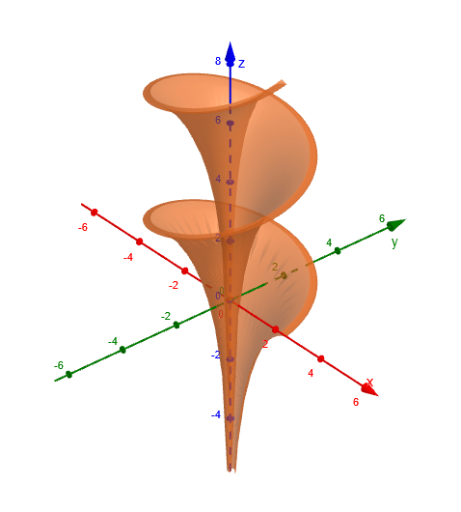
Loading the math board and drawing, please wait…
This example demonstrates the famous Dini's Surface, a helical surface with constant negative Gaussian curvature discovered by Italian mathematician Ulisse Dini. The core mathematical concepts include parametric surface equations, constant negative curvature, helical surface construction methods, and the differential geometric properties of surfaces. Construction details: Using GeoGebra's Surface command with parametric equations x=a·cos(u)·sin(v), y=a·sin(u)·sin(v), z=a·(cos(v)+ln(tan(v/2))+c·u), where parameter a controls the overall scale of the surface and parameter c determines the degree of helical twist, while sliders b, d, and e are used to dynamically adjust the surface morphology. Suitable for differential geometry, parametric surface studies, and visualization teaching in university mathematics courses, also serving as an introductory example for mathematics majors to understand negative curvature surfaces.
GeoGebra Commands & Parameters
Surface(((a * cos(u)) * sin(v)), ((a * sin(u)) * sin(v)), (a * (cos(v) + ln(tan((0.5 * v))))) + (b * u), u, 0, 12.566370614359172, v, 0.01, 2) → c
AI Drawing Prompt Reference
Draw a helical surface with constant negative Gaussian curvature, known as Dini's surface. The surface is defined by parametric equations where parameter a controls the overall scale and parameter b controls the degree of helical twist. The shape resembles a twisted funnel or spiral horn with a smooth surface and periodic rotation. Use two sliders to adjust a and b dynamically, changing the size and twist of the surface. Set the parameter ranges: u from 0 to about 4π, v from near 0 to 2, then generate the surface based on the equations, displaying it with a mesh or shading to highlight its geometric properties.
The prompt above was compiled from the original drawing commands and is for reference only.