
Dynamic Demonstration of Triangle's Orthocenter & Midpoint
Loading the math board and drawing, please wait…
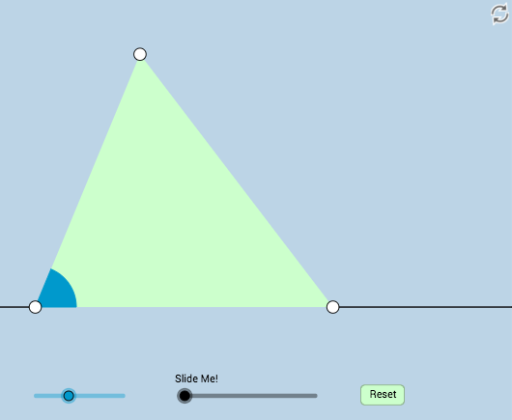
This example dynamically illustrates the geometric relationship between a triangle's orthocenter and the midpoint of one side. It involves core mathematical concepts such as orthocenter, midpoint, vectors, rotation, and geometric transformations. The construction utilizes commands like Rotate, Angle, Segment, Ray, Point, Circle, Intersect, CircleSector, Line, OrthogonalLine, Polygon, Midpoint, and Dilate from GeoGebra. It is suitable for high school and above students to understand triangle geometry and dynamic geometric transformations.
GeoGebra Commands & Parameters
Rotate(A, (a * π / 180), B) → A'Angle(A, B, A') → αSegment(B, A) → fRay(B, A') → gPoint(g) → CSegment(B, C) → hCircle(B, b) → cIntersect(c, f, 1) → DIntersect(c, h, 1) → ECircleSector(B, D, E) → dSegment(C, A) → iLine(C, A) → jLine(A, B) → kOrthogonalLine(C, k) → mIntersect(m, k) → HCircle(C, 2) → eCircle(H, 2) → pIntersect(e, j, 1) → JRay(C, J) → nLine(C, H) → rPolygon(B, A, C) → poly1, c_1, b_1, a_1Angle(C, A, B) → βMidpoint(f) → IAngle(A, H, C) → δLine(C, B) → lOrthogonalLine(A, l) → qIntersect(q, l) → FAngle(B, F, A) → γIntersect(q, r) → GSegment(C, H) → sLine(C, H) → tCircle(C, 2) → d_1Circle(H, 2) → e_1Intersect(d_1, t, 1) → LIntersect(e_1, t) → M, NRay(C, L) → f_1Ray(H, N) → g_1Segment(C, H) → h_1Midpoint(C, G) → OCircle(B, 1) → k_1Circle(A, 1) → p_1Intersect(k_1, k, 2) → PIntersect(p_1, k, 1) → QRay(B, P) → i_1Ray(A, Q) → j_1Dilate(B, If[0 < o ≤ 1, 1 - o, 0], I) → B'Segment(B, B') → l_1Rotate(B, If[1 < o ≤ 2, ((-(o - 1)) * π), (-π)], I) → B'_1Rotate(B', If[1 < o ≤ 2, ((-(o - 1)) * π), (-π)], I) → B''Segment(B'_1, B'') → m_1Intersect(k_1, l, 2) → KCircle(C, 2) → q_1Intersect(q_1, l, 1) → RSegment(B, C) → n_1Ray(C, R) → r_1Ray(B, K) → s_1Dilate(A, If[2 < o ≤ 3, 3 - o, 0], F) → A'_1Segment(A, A'_1) → t_1Dilate(C, If[3 < o ≤ 4, 4 - o, 0], O) → C'Segment(C, C') → f_2Dilate(O, If[4 < o ≤ 5, 5 - o, 0], G) → O'Segment(O, O') → g_2Dilate(G, If[5 < o ≤ 6, 6 - o, 0], H) → G'Segment(G, G') → h_2Rotate(C, If[6 < o ≤ 7, ((-(o - 6)) * π), (-π)], O) → C'_1Rotate(C', If[6 < o ≤ 7, ((-(o - 6)) * π), (-π)], O) → C''Segment(C'_1, C'') → i_2Angle(I, F, O) → εDilate(I, If[8 < o ≤ 9, 9 - o, 0], F) → I'Dilate(O, If[8 < o ≤ 9, 9 - o, 0], F) → O'_1Segment(I, I') → j_2Segment(O, O'_1) → k_2Line(A, F) → l_2Line(C, B) → m_2