
Dynamic Demonstration of Triangle Medians
Loading the math board and drawing, please wait…
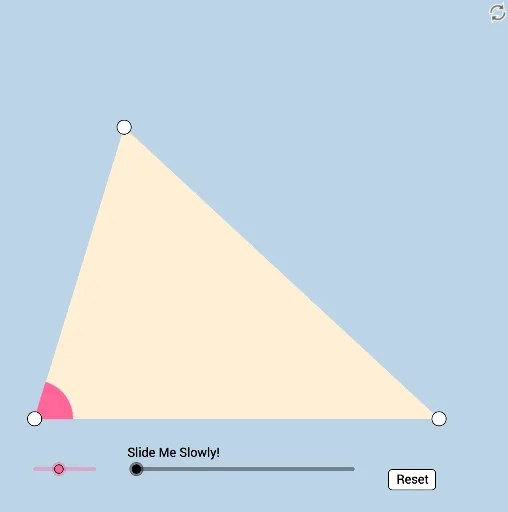
This example demonstrates the dynamic properties of triangle medians. Key concepts include the centroid of a triangle, parallelograms, and triangle properties. Using GeoGebra commands such as Midpoint, Segment, Rotate, etc., the shape of the triangle can be dynamically adjusted to observe the changes in the medians.
GeoGebra Commands & Parameters
Midpoint(A, C) → M_BSegment(M_B, C) → j_3Segment(A, M_B) → i_3Rotate(C, (a * π / 180), A) → C'Ray(A, C') → gPoint(g) → BMidpoint(A, B) → M_CSegment(M_C, A) → q_3Segment(B, M_C) → n_3Midpoint(C, B) → M_ASegment(M_A, B) → m_3Segment(C, M_A) → l_3Segment(A, C) → fAngle(C, A, C') → αSegment(C, B) → hRay(M_B, M_A) → iLine(A, C) → jLine(B, j) → kIntersect(k, i) → DPolygon(A, B, C) → poly1, c, a_1, bPolygon(M_C, D, C) → poly2, c_1, m_c, dSegment(B, M_B) → lSegment(C, D) → mSegment(A, C) → nSegment(A, M_A) → pSegment(M_C, D) → qSegment(M_A, D) → rSegment(A, B) → sIntersect(q, h) → EOrthogonalLine(M_A, m) → tIntersect(l, p) → GOrthogonalLine(G, n) → f_1Segment(D, M_B) → g_1Dilate(A, If[0 < v ≤ 1, 1 - v, 0], M_B) → A'Dilate(C, If[0 < v ≤ 1, 1 - v, 0], M_A) → C'_1Segment(A, A') → h_1Segment(C, C'_1) → i_1Dilate(B, If[0 < v ≤ 1, 1 - v, 0], M_C) → B'Segment(B, B') → j_1Rotate(A, If[1 < v ≤ 2, ((-(v - 1)) * π), (-π)], M_B) → A'_1Rotate(A', If[1 < v ≤ 2, ((-(v - 1)) * π), (-π)], M_B) → A''Segment(A'_1, A'') → k_1Rotate(C, If[1 < v ≤ 2, ((-(v - 1)) * π), (-π)], M_A) → C'_2Rotate(C'_1, If[1 < v ≤ 2, ((-(v - 1)) * π), (-π)], M_A) → FSegment(C'_2, F) → l_1Rotate(B, If[1 < v ≤ 2, ((-(v - 1)) * π), (-π)], M_C) → B'_1Rotate(B', If[1 < v ≤ 2, ((-(v - 1)) * π), (-π)], M_C) → B''Segment(B'_1, B'') → m_1Min({i_3, j_3, l_3, m_3, n_3, q_3}) → wCircle(A, (0.25 * w)) → d_1Intersect(d_1, j) → I, JCircle(C, (0.25 * w)) → e_1Intersect(e_1, j) → K, LIntersect(d_1, g) → M,CircleSector(A, J, M) → p_1Line(D, C) → n_1Intersect(e_1, n_1) → N, OAngle(L, C, N) → βLine(M_C, D) → q_1Line(A, M_A) → r_1Line(D, M_A) → s_1Circle(D, (0.25 * w)) → t_1Intersect(t_1, q_1) → R, SIntersect(t_1, s_1) → T, UCircleSector(D, R, U) → c_2Dilate(B, If[2 < v ≤ 3, 3 - v, 0], M_B) → B'_2Dilate(A, If[2 < v ≤ 3, 3 - v, 0], M_A) → A'_2Dilate(C, If[2 < v ≤ 3, 3 - v, 0], M_C) → C'_3Segment(B, B'_2) → b_1Segment(A, A'_2) → f_2Segment(C, C'_3) → g_2Circle(B, 1) → d_2Intersect(d_2, g, 2) → HRay(B, H) → h_2Dilate(M_C, If[6 < v ≤ 7, 7 - v, 0], D) → PDilate(B, If[4 < v ≤ 5, 5 - v, 0], D) → B'_3Ray(B, D) → i_2Circle(D, 1) → e_2Intersect(e_2, i_2, 2) → QRay(D, Q) → j_2Segment(B, B'_3) → k_2Segment(M_C, P) → l_2Dilate(M_B, If[3 < v ≤ 4, 4 - v, 0], M_A) → VSegment(M_B, V) → m_2Dilate(M_A, If[4 < v ≤ 5, 5 - v, 0], D) → WSegment(M_A, W) → n_2Dilate(A, If[5 < v ≤ 6, 6 - v, 0], B) → A'_3Vector(A, A'_3) → u_1Translate(p_1, u_1) → p_2Ray(C, L) → q_2Dilate(C, If[6 < v ≤ 7, 7 - v, 0], D) → C'_4Segment(C, C'_4) → r_2Ray(M_B, D) → s_2Circle(D, 1) → t_2Intersect(t_2, s_2) → Z, A_1Ray(D, A_1) → a_2Ray(D, M_C) → b_2Circle(M_C, 1) → c_3Intersect(c_3, b_2, 2) → B_1Ray(M_C, B_1) → f_3Dilate(B, If[8 < v ≤ 9, 9 - v, 0], D) → B'_4Vector(B, B'_4) → v_1Translate(p_2, v_1) → d_3Rotate(L, If[9 < v ≤ 10, ((v - 9) * β), β], C) → L'CircleSector(C, L, L') → e_3Dilate(C, If[10 < v ≤ 11, 11 - v, 0], M_B) → C'_5Vector(C, C'_5) → w_1Translate(e_3, w_1) → g_3Angle(R, D, U) → γRotate(R, If[11 < v ≤ 12, ((v - 11) * γ), γ], D) → R'CircleSector(D, R, R') → h_3Dilate(D, If[12 < v ≤ 13, 13 - v, 0], M_C) → D'Dilate(D, If[13 < v ≤ 14, 14 - v, 0], M_A) → D'_1Vector(D, D') → u_2Translate(h_3, u_2) → k_3Vector(D, D'_1) → v_2Translate(h_3, v_2) → p_3
AI Drawing Prompt Reference
Draw a triangle to dynamically demonstrate its medians. First, plot the three vertices of the triangle and find the midpoint of each side. Connect each vertex to its opposite midpoint to form the three medians. Then, rotate and adjust the size of the triangle while observing the changes in the medians. Additionally, draw the parallelogram formed by the medians and highlight the centroid of the triangle. Finally, show the intersection points of the medians with the opposite sides and the parallelogram formed by the medians.
The prompt above was compiled from the original drawing commands and is for reference only.