
Dynamic Demonstration of Rhombus and Parabola
Loading the math board and drawing, please wait…
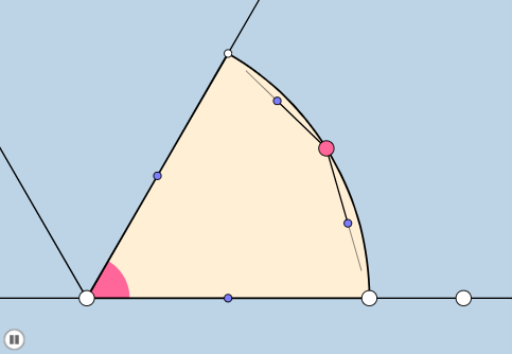
This example demonstrates the dynamic relationship between a rhombus and a parabola. Key mathematical concepts include the properties of a rhombus, the definition of a parabola, and its combination with vectors. Using GeoGebra commands such as Ray, Point, Segment, Rotate, Intersect, etc., the dynamic transformation process of the rhombus is constructed. Suitable for high school mathematics education and learning.
GeoGebra Commands & Parameters
Ray(A, B) → jPoint(j) → DSegment(A, D) → r_1Line(A, B) → fRotate(B, π / 3, A) → B'Angle(B, A, B') → αRotate(B', π / 3, A) → B''Angle(B', A, B'') → βRay(A, B'') → gRay(A, B') → hPoint(h) → CMirror(B, A) → B'_1Segment(C, D) → iRay(A, B'_1) → kSegment(A, D) → lSegment(A, C) → mCircle(A, (0.15 * r_1)) → cIntersect(c, k, 1) → EIntersect(c, g) → F,CircleSector(A, F, E) → dRotate(d, If[0 < a ≤ 1, ((-a) * π / 3), ((-π)) / 3], A) → d'Rotate(d', If[2 < a ≤ 3, ((-(a - 2)) * π / 3), ((-π)) / 3], A) → d''Line(A, C) → nOrthogonalLine(D, n) → pIntersect(n, p) → JLine(A, D) → qOrthogonalLine(C, q) → rIntersect(r, q) → HLine(A, C) → n_1Circle(C, 1) → e_1Intersect(e_1, n_1, 2) → NCircle(A, 1) → p_1Intersect(p_1, n_1) → O, PRay(A, D) → s_1Circle(D, 1) → t_1Intersect(t_1, s_1) → Q, RLine(A, C) → q_1Circle(A, D) → c_1Intersect(c_1, q_1) → U, VCircleArc(A, D, V) → ePoint(e) → GRay(D, B) → sMidpoint(A, D) → IDilate(A, If[3 < a ≤ 4, 4 - a, 0], I) → A'Circle(V, 1) → tMidpoint(A, V) → KMidpoint(G, V) → LMidpoint(D, G) → SDistance(I, S) → distanceISDistance(S, L) → distanceSLDistance(L, K) → distanceLKDistance(K, I) → distanceKIIntersect(t, q_1, 2) → TRay(V, T) → bDilate(A, If[3 < a ≤ 4, 4 - a, 0], K) → A'_1Segment(A, A') → f_1Segment(A, A'_1) → g_1Rotate(A, If[4 < a ≤ 5, ((-(a - 4)) * π), (-π)], I) → A'_2Rotate(A', If[4 < a ≤ 5, ((-(a - 4)) * π), (-π)], I) → A''Segment(A'_2, A'') → h_1Rotate(A, If[4 < a ≤ 5, ((-(a - 4)) * π), (-π)], K) → A'_3Rotate(A'_1, If[4 < a ≤ 5, ((-(a - 4)) * π), (-π)], K) → WSegment(A'_3, W) → i_1Dilate(G, If[5 < a ≤ 6, 6 - a, 0], S) → G'Dilate(G, If[5 < a ≤ 6, 6 - a, 0], L) → G'_1Segment(G, G') → a_1Segment(G, G'_1) → b_1Dilate(L, If[6 < a ≤ 7, 7 - a, 0], V) → L'Dilate(S, If[6 < a ≤ 7, 7 - a, 0], D) → S'Segment(L, L') → d_1Segment(S, S') → f_2Rotate(G, If[7 < a ≤ 8, ((a - 7) * π), π], S) → G'_2Rotate(G', If[7 < a ≤ 8, ((a - 7) * π), π], S) → G''Segment(G'_2, G'') → j_1Rotate(G, If[7 < a ≤ 8, ((a - 7) * π), π], L) → G'_3Rotate(G'_1, If[7 < a ≤ 8, ((a - 7) * π), π], L) → ZSegment(G'_3, Z) → k_1Dilate(I, If[8 < a ≤ 9, 9 - a, 0], S) → I'Segment(I, I') → l_1Angle(S, I, K) → γRotate(I, If[9 < a ≤ 10, ((a - 9) * γ), γ], I) → I'_1Rotate(I', If[9 < a ≤ 10, ((a - 9) * γ), γ], I) → I''Segment(I'_1, I'') → m_1Dilate(I, If[10 < a ≤ 11, 11 - a, 0], K) → I'_2Vector(I, I'_2) → uTranslate(I, u) → I'_3Translate(I', u) → I''_1Segment(I'_3, I''_1) → g_2Dilate(K, If[11 < a ≤ 12, 12 - a, 0], L) → K'Vector(K, K') → vTranslate(I'_1, v) → MTranslate(I'', v) → I'''Segment(M, I''') → h_2CircleSector(A, D, V) → c_2Polygon(I, S, L, K) → poly1, i_2, s_2, l_2, k_2