
Dynamic Cone and Pyramid Volume Relationship
Loading the math board and drawing, please wait…
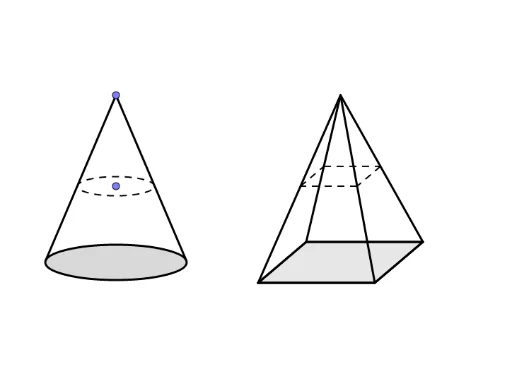
This example dynamically explores the relationship between the volumes of a cone and a square pyramid using cross-sectional areas. Key math concepts include volume formulas, cross-sectional areas, centroid or barycenter, geometric division, and square roots. GeoGebra commands like Line, OrthogonalLine, Point, Tangent, Intersect, Segment, Circle, LineBisector, and Polygon are used to construct the model. It is suitable for high school solid geometry instruction to enhance understanding of volume formulas and spatial visualization.
GeoGebra Commands & Parameters
Line(B, A) → fOrthogonalLine(E, f) → gPoint(g) → FTangent(F, c) → h, iIntersect(c, h, 1) → CIntersect(c, i, 1) → DSegment(F, C) → jSegment(F, D) → kLine(F, f) → lSegment(F, E) → rPoint(r) → KOrthogonalLine(K, r) → tSegment(K, E) → eLine(G, H) → mLine(I, G) → nLine(H, n) → pLine(I, m) → qCircle(G, I) → dIntersect(d, n, 2) → JLine(J, m) → sIntersect(p, q) → LIntersect(p, s) → MLineBisector(H, G) → f_1Intersect(m, f_1) → NIntersect(l, f_1) → OSegment(I, J) → g_1Segment(J, M) → h_1Segment(M, L) → i_1Segment(L, I) → j_1Segment(I, O) → k_1Segment(J, O) → l_1Segment(M, O) → m_1Segment(L, O) → n_1Polygon(I, J, M, L) → poly1, i_2, j_2, m_2, l_2Segment(O, N) → p_1Intersect(t, p_1) → PIntersect(t, k_1) → QIntersect(t, n_1) → RLine(Q, g_1) → q_1Line(R, i_1) → r_1Intersect(q_1, l_1) → SIntersect(r_1, m_1) → TSegment(S, T) → s_1Segment(T, R) → t_1Segment(R, Q) → a_1Segment(Q, S) → b_1