
Dynamic and Modifiable Geometric Problem Illustration
Loading the math board and drawing, please wait…
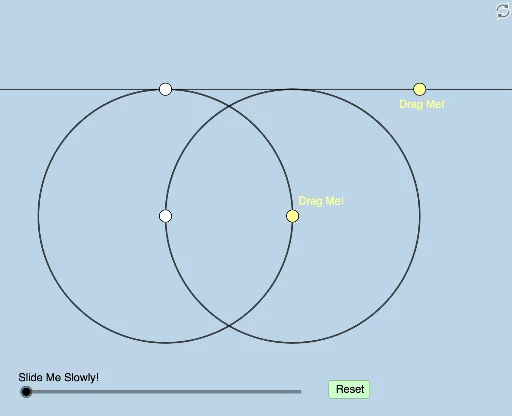
This example dynamically demonstrates a geometric problem from Antonio Gutierrez, involving elements like 2D vectors, prisms, and circumcircles. Key math concepts include 2D vectors, circumcircles, definite integrals, and equations. Construction highlights the use of GeoGebra commands/objects such as Circle, Point, Line, OrthogonalLine, Intersect, Ray, Angle, Radius, Dilate, Segment, Rotate, Polygon, Midpoint, CircleSector, Vector, and Translate. Suitable for high school and above, helping learners understand vector operations, geometric transformations, and integral applications.
GeoGebra Commands & Parameters
Circle(A, B) → cPoint(c) → CCircle(C, A) → dLine(A, C) → fOrthogonalLine(C, f) → gIntersect(d, g, 2) → DIntersect(d, g, 1) → ELine(D, A) → hIntersect(c, h, 1) → FIntersect(c, d, 2) → GRay(F, G) → iAngle(A, F, G) → αRadius(c) → bDilate(A, If[0 < e ≤ 1, 1 - e, 0], C) → A'Segment(A, A') → jRotate(A, If[1 < e ≤ 2, ((e - 1) * π / 3), π / 3], C) → A'_1Rotate(A', If[1 < e ≤ 2, ((e - 1) * π / 3), π / 3], C) → A''Segment(A'_1, A'') → j'Rotate(A'_1, If[2 < e ≤ 3, ((e - 2) * π / 3), π / 3], G) → IRotate(A'', If[2 < e ≤ 3, ((e - 2) * π / 3), π / 3], G) → A'''Segment(I, A''') → j''Polygon(A, G, C) → t1, c_1, a_1, g_1Rotate(G, If[3 < e ≤ 4, ((e - 2) * π / 3), π / 3], G) → G'Midpoint(C, G) → JDilate(A, If[4 < e ≤ 5, 5 - e, 0], J) → A'_2Segment(A, A'_2) → lCircle(A, (0.3 * b)) → pLine(A, C) → mIntersect(p, m) → K, LRotate(L, If[5 < e ≤ 6, ((-(e - 5)) * π / 6), ((-π)) / 6], A) → L'CircleSector(A, L', L) → qRotate(q, If[7 < e ≤ 8, ((-(e - 7)) * π / 6), ((-π)) / 6], A) → q'Line(H, j'') → nLine(H, l) → rCircle(H, 2) → sIntersect(s, n, 1) → MIntersect(s, k) → N, OAngle(M, H, O) → βDilate(A, If[9 < e ≤ 10, 10 - e, 0], H) → A'_3Vector(A, A'_3) → uTranslate(q', u) → q''Rotate(q'', If[9 < e ≤ 10, ((e - 9) * β), β], A'_3) → q'''Circle(H, (0.55 * b)) → tIntersect(t, k) → P, QRotate(Q, π / 6, H) → Q'Segment(H, Q') → f_1Rotate(Q', (5 * π / 24), H) → Q''Rotate(Q'', (5 * π / 24), H) → Q'''Rotate(Q''', (5 * π / 24), H) → RCircle(H, (0.3 * b)) → d_1Ray(H, Q') → h_1Intersect(d_1, h_1) → S,Dilate(H, If[10 < e ≤ 11, 11 - e, 0], Q') → H'Dilate(H, If[10 < e ≤ 11, 11 - e, 0], Q'') → H'_1Dilate(H, If[10 < e ≤ 11, 11 - e, 0], Q''') → H'_2Dilate(H, If[10 < e ≤ 11, 11 - e, 0], R) → H'_3Segment(H, H') → i_1Segment(H, H'_1) → j_1Segment(H, H'_2) → k_1Segment(H, H'_3) → l_1Rotate(S, If[11 < e ≤ 12, (((e - 11) * 5) * π / 24), (5 * π / 24)], H) → S'CircleSector(H, S, S') → e_1Rotate(e_1, If[13 < e ≤ 14, (((e - 13) * 5) * π / 24), (5 * π / 24)], H) → p_1Rotate(p_1, If[15 < e ≤ 16, (((e - 15) * 5) * π / 24), (5 * π / 24)], H) → q_1Rotate(q_1, If[17 < e ≤ 18, (((e - 17) * 5) * π / 24), (5 * π / 24)], H) → r_1Dilate(C, If[20 < e ≤ 21, 21 - e, 0], E) → C'Dilate(C, If[20 < e ≤ 21, 21 - e, 0], D) → C'_1Segment(C, C'_1) → m_1Segment(C, C') → n_1Angle(D, C, A) → γDilate(D, If[21 < e ≤ 22, 22 - e, 0], F) → D'Segment(D, D') → s_1Dilate(F, If[22 < e ≤ 23, 23 - e, 0], A) → F'Segment(F, F') → t_1Dilate(F, If[23 < e ≤ 24, 24 - e, 0], G') → F'_1Segment(F, F'_1) → b_1Line(F, k) → f_2Point(f_2) → TAngle(T, F, G) → δDilate(H, If[25 < e ≤ 26, 26 - e, 0], F) → H'_4Vector(H, H'_4) → vTranslate(r_1, v) → c_2Rotate(c_2, If[25 < e ≤ 26, ((e - 25) * δ), δ], H'_4) → d_2