
Does Wearing a Large Shirt Increase IQ Math Demo
Loading the math board and drawing, please wait…
In collections
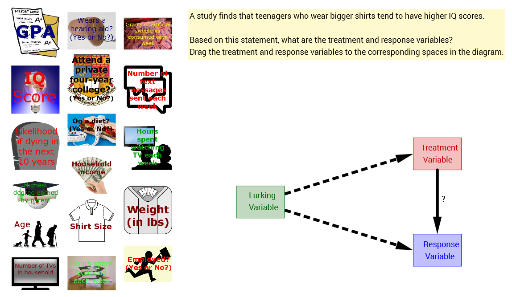
Confounding Variables
This example demonstrates the hypothesis of IQ increase with large shirts using geometric constructs. Core math concepts include vectors, polygon construction, and length calculations. GeoGebra commands like Polygon, Point, Vector, Segment, and Length are utilized. Suitable for high school mathematics education, showcasing data visualization and geometric construction integration.
GeoGebra Commands & Parameters
Polygon(F, treatment, H, I) → treatmentPoly, f, g, h, iPolygon(J, response, L, M) → responsePoly, j, k, l, mPoint(g) → NPoint(m) → OVector(N, O) → uVector((0, 7), B) → vVector((0, 5), C) → wPolygon(A, P, lurking, R) → poly1, a, p, q, rSegment(shirt, treatment) → treatmentSegSegment(iqScore, response) → responseSegSegment(age, lurking) → lurkingSegLength(lurkingSeg) → lurkingLenLength(treatmentSeg) → treatmentLenLength(responseSeg) → responseLen
AI Drawing Prompt Reference
Draw a geometric figure to demonstrate the relationship between wearing large shirts and IQ. First, draw two polygons, one representing people wearing large shirts and the other representing IQ scores. Then, draw points N and O inside the polygons to represent vectors u for wearing large shirts and IQ scores. Next, draw two vectors v and w for age and lurking variables. Finally, calculate the lengths of these vectors to show the impact of wearing large shirts, IQ scores, and age.
The prompt above was compiled from the original drawing commands and is for reference only.