
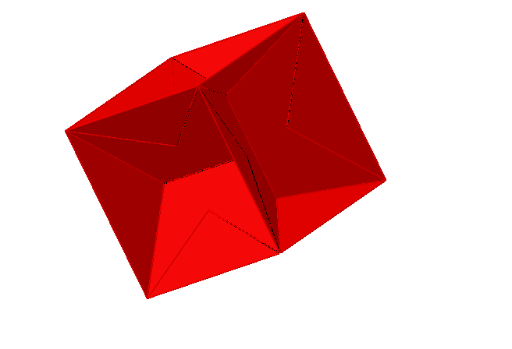
Dodecahedron Inverted in a Cube
Loading the math board and drawing, please wait…
In collections
My 3D Collection
This example demonstrates the inversion of a dodecahedron inside a cube, showcasing spatial relationships and symmetry. It involves core math concepts like solid geometry, polygons, transformations, and spatial symmetry. The construction uses commands like Point, Dodecahedron, Cube, Mirror, Segment, Polygon, and objects A, B, C, etc. It is suitable for high school students and math enthusiasts exploring spatial geometry and polyhedron properties.
GeoGebra Commands & Parameters
Point(Circle[(((0, 0) * (1 - sqrt(5))) + ((0, 1) * (3 + sqrt(5)))) / 4, (Distance[(0, 0), (0, 1)] * sqrt(10 + (2 * sqrt(5))) / 4), Segment[(0, 0), (0, 1)]]) → ADodecahedron((0, 0), (0, 1), A) → a, B, K, L, M, N, O, P, Q, R, face1, face3, C, face2, face4, faceABFKE, faceBCGLF, faceGLQRM, faceHINRM, faceDINOJ, faceEJOPK, faceFKPQL, faceNOPQR, D, edge2, edge1, edge4, edgeAB, edgeBC, edge3, edgeCG, edgeGM, edgeHM, edgeHI, E, edgeDI, edge5, edgeDJ, edgeEJ, edgeAE, edgeEK, edgeFK, edgeBF, edgeFL, edgeGL, F, edgeLQ, edgeQR, edgeMR, edgeNR, edgeIN, edgeNO, edgeJO, edgeOP, edgeKP, edgePQ, G, H, I, JPoint(edge4) → SCube(E, O, Q) → b, T, faceQTZW, faceUVWZ, edgeET, edgeEO, edgeOQ, edgeQT, edgeEU, edgeTZ, edgeUZ, edgeUV, U, edgeOV, edgeVW, edgeQW, edgeWZ, V, W, Z, faceEOQT, faceETZU, faceEOVU, faceOQWVMirror(N, faceOQWV) → N'Mirror(R, faceOQWV) → R'Mirror(J, faceEOVU) → J'Mirror(D, faceEOVU) → D'Mirror(A, faceETZU) → A'Mirror(B, faceETZU) → B'Mirror(H, faceUVWZ) → H'Mirror(A_1, faceUVWZ) → B_1Mirror(L, faceQTZW) → L'Mirror(G, faceQTZW) → G'Mirror(K, faceEOQT) → K'Mirror(P, faceEOQT) → P'Mirror(K, faceEOQT) → K'_1Segment(J', O) → hSegment(J', E) → iSegment(A', E) → kSegment(A', S) → lSegment(B', T) → mSegment(B', Z) → nSegment(B', A') → pSegment(B_1, S) → qSegment(B_1, Z) → rSegment(D', V) → fSegment(D', S) → gSegment(D', J') → jSegment(H', V) → sSegment(H', W) → tSegment(H', B_1) → cSegment(W, G') → dSegment(G', Z) → eSegment(Q, L') → f_1Segment(L', T) → g_1Segment(Q, R') → i_1Segment(R', W) → j_1Segment(N', O) → k_1Segment(N', V) → l_1Segment(O, P') → m_1Segment(Q, P') → n_1Segment(R', N') → q_1Segment(L', G') → p_1Polygon(O, N', R', Q) → poly1, o, n', r', q_2Polygon(N', V, W, R') → poly2, n'_1, v, w, r'_1Polygon(O, J', D', V) → poly3, o_1, j', d', v_1Polygon(E, J', D', S) → poly5, e_1, j'_1, d'_1, s_1Polygon(G', L', Q, W) → poly4, g', l'_2, q_3, w_1Polygon(Z, G', L', T) → poly8, z_1, g'_1, l'_3, t_2Polygon(Q, P', K', T) → poly6, q_4, p', k', t_1Polygon(P', O, E, K') → poly7, p'_1, o_2, e_2, k'_1Polygon(T, E, A', B') → poly9, t_3, e_3, a', b'Polygon(Z, B', A', S) → poly10, z_2, b'_1, a'_1, s_2Polygon(H', W, Z, B_1) → poly11, h', w_2, z_3, b_1Polygon(V, H', B_1, S) → poly12, v_2, h'_1, b_2, s_3