
Discrete Hexagonal–Triangular Network Generated by a Quadratic Polynomial
Loading the math board and drawing, please wait…
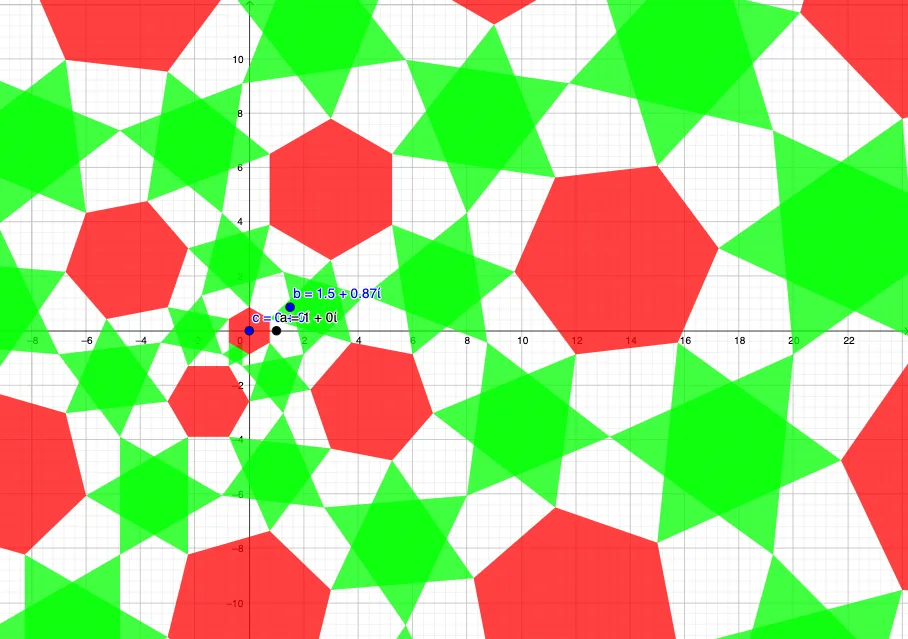
This example demonstrates how to build a discrete geometric network on hexagonal and triangular lattices by evaluating and using a degree-2 (quadratic) polynomial to drive point placement and polygon/edge connectivity. The key math concepts include quadratic functions (discrete polynomial values on lattice points), geometric transformations and similarity mapping to reuse local patterns across the lattice, and the iterative/discrete nature of construction via sequences. In GeoGebra, the construction is reflected by using Sequence to generate parameter/index lists (e.g., n, u, t1, A, T, B), Polygon to assemble lattice-based polygonal network components (e.g., poly1, L_1, L_2, L_3), and Flatten to transform nested structures of points/segments into a drawable form (e.g., flT, flH, fpT, fpH). Suitable for advanced high school through introductory university topics such as discrete geometry visualization, function-driven construction, and understanding how transformations affect repeated geometric patterns.
GeoGebra Commands & Parameters
Sequence(Sequence[(k * (2 - u)) + (l * (1 + u)), k, (-n) - 1, n], l, (-n) - 1, n) → TPolygon(Sequence[u^(k), k, 0, 5]) → poly1Flatten(T) → flTSequence(Join[Sequence[{(k * (2 - u)) + 1 + (l * (1 + u)), (k * (2 - u)) + u + (l * (1 + u))}, k, (-n) - 1, n]], l, (-n) - 1, n) → HFlatten(H) → flHPolygon(A, B, 3) → t1, f, g, h, CSequence((a * flH(k)^(2)) + (b * flH(k)) + c, k, 1, Length[flH]) → fHSequence((a * flT(k)^(2)) + (b * flT(k)) + c, k, 1, Length[flT]) → fTSequence(((2 * a) * flT(k)) + b, k, 1, Length[flT]) → fpTSequence(((2 * a) * flH(k)) + b, k, 1, Length[flH]) → fpHSequence(Translate[Dilate[Rotate[poly1, arg(fpT(k))], (v * abs(fpT(k)))], fT(k)], k, 1, Length[fT]) → L_2Sequence(Translate[Dilate[Rotate[{t1, Rotate[t1, π]}, arg(fpH(k))], (v * abs(fpH(k)))], fH(k)], k, 1, Length[fH]) → L_3
AI Drawing Prompt Reference
Create a hexagonal-triangular network using a quadratic polynomial to generate points on a lattice. First, generate parameter list T, then draw a pentagon poly1. Next, create horizontal and vertical segment lists flH and flT, and use transformations to generate a series of hexagons L_2 and triangles L_3, forming a complex geometric network.
The prompt above was compiled from the original drawing commands and is for reference only.