
Polygon Fractal Flower: Affine Scaling Geometry Construction
Loading the math board and drawing, please wait…
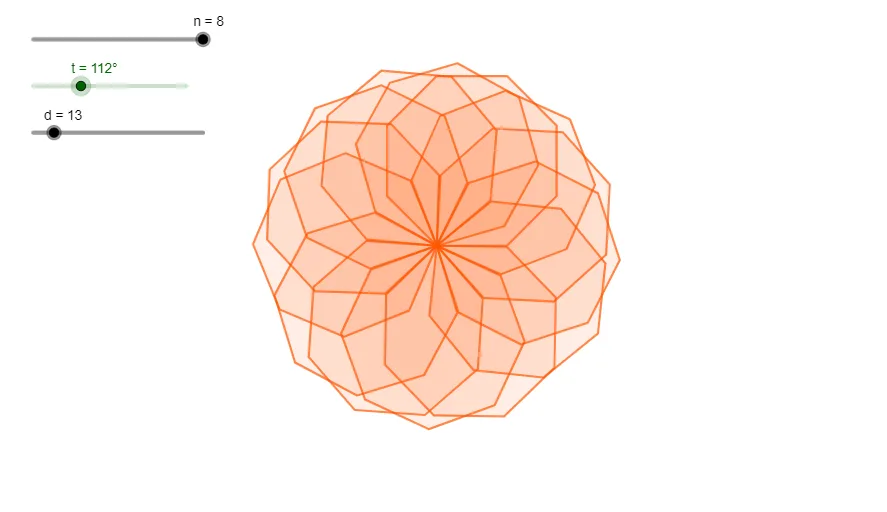
This example demonstrates how to create a flower-like fractal pattern by iteratively generating and transforming polygonal shapes. It centers on concepts such as dilation (scaling/expansion), fractal geometry (iteration), and affine-style constructions linked to parallelograms, while combining trapezoids and a parabola-shaped geometric structure to form coherent “petals.” In the GeoGebra construction, key commands include Point and Polygon to define vertices and polygonal tiles, and Sequence to produce an iteration index that drives step-by-step growth from an initial polygon (e.g., poly1) to multiple transformed copies. The construction summary also indicates several transformation-related objects (functions/mappings denoted by f, g, h, i, j, k, l, m), along with controlling parameters/values (such as t and d) and many auxiliary points (A, B, C…H, etc.) that determine the geometry at each iteration. Suitable for upper secondary enrichment, contest geometry, and learners studying transformation-based construction and fractal generation through interactive math visualization.
GeoGebra Commands & Parameters
Point(xAxis) → APoint(xAxis) → BPolygon(A, B, n) → poly1, f, D, E, F, G, H, g, h, i, j, k, l, m, CSequence(Rotate[poly1, (t * k), A], k, 0, d) → poly1'
AI Drawing Prompt Reference
On a plane, first mark two starting points along the coordinate axes and use them to build an initial polygon “petal” shape by connecting its vertices. Then repeatedly generate new copies from this original polygon: for each iteration, rotate the current polygon about a fixed center by an angle proportional to the iteration index times a parameter, and apply a linked scaling/dilation parameter also driven by that index, for a total of d steps. The transformed polygon pieces should accumulate around the center, producing a polygonal fractal flower pattern with coherent, petal-like structure formed through iterative affine-style transformations.
The prompt above was compiled from the original drawing commands and is for reference only.