
Directional Derivatives
Loading the math board and drawing, please wait…
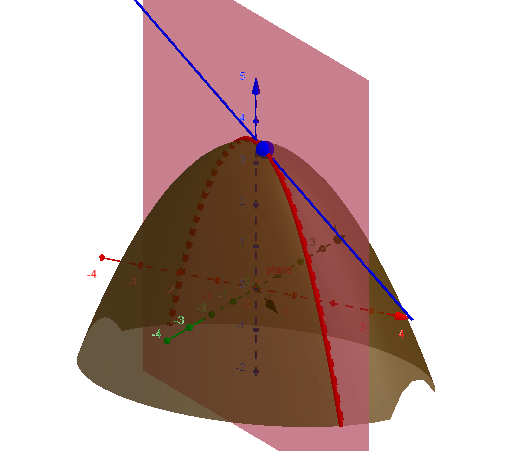
This example illustrates the concept of directional derivatives. Using analytic geometry, vectors, and functions, it demonstrates how to calculate the rate of change of a function at a point in a specific direction. The construction involves commands like Plane, IntersectPath, Vector, and Line. Suitable for university-level calculus courses.
GeoGebra Commands & Parameters
Plane(A, B, C) → planeIntersectPath(plane, f) → curveVector((cos(θ), sin(θ), m)) → vLine(Q, v) → line
AI Drawing Prompt Reference
Create a 3D coordinate system with a surface function and a plane defined by three points. The plane intersects the surface, producing a space curve that illustrates the geometric meaning of directional derivatives. At a point on the surface, construct a direction vector whose orientation is determined by an angle parameter, and draw a line along that direction to represent the rate of change of the function. The overall figure should clearly show the relationships among the surface, plane, intersection curve, direction vector, and line, suitable for university-level calculus instruction.
The prompt above was compiled from the original drawing commands and is for reference only.