
Dilations Part 2: Similarity Transformations
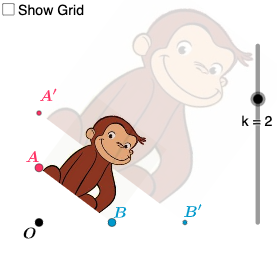
Loading the math board and drawing, please wait…
In collections
Exploring Dilations
This example dynamically demonstrates geometric dilations to illustrate similarity transformations and properties of similar triangles. Key math concepts include similarity transformations, similarity criteria, matrix transformations, and coordinate changes of special points (centers, vertices). Constructed using GeoGebra commands like Segment, Dilate, OrthogonalLine, Circle, Intersect, Point, and Line. Suitable for high school students studying geometric transformations, similarity, and matrix applications, as well as exploring geometric distributions and limits.
GeoGebra Commands & Parameters
Segment(A, B) → fDilate(pic1, k, C) → pic1'Dilate(A, k, C) → A'Dilate(B, k, C) → B'Segment(A', B') → f'Segment(C, A) → gSegment(C, B) → iSegment(A, A') → hSegment(B, B') → jOrthogonalLine(C, g) → lOrthogonalLine(A', h) → mCircle(C, 1.5) → cIntersect(c, l, 2) → DOrthogonalLine(D, l) → nOrthogonalLine(C, j) → pOrthogonalLine(B', j) → qIntersect(c, p, 1) → EOrthogonalLine(E, p) → rIntersect(q, r) → FIntersect(m, n) → GPoint(m) → HOrthogonalLine(H, m) → sIntersect(l, s) → ISegment(H, I) → tLine(C, E) → aPoint(q) → JOrthogonalLine(J, q) → bIntersect(a, b) → KSegment(J, K) → d
AI Drawing Prompt Reference
Draw a dilation transformation centered at point C. Start with triangle ABC, where A and B are vertices and C is the center. Construct a small circle centered at C, and draw perpendicular lines from C to the sides of the triangle. Dilate triangle ABC by a scale factor k (controlled by a slider) from point C to get new triangle A'B'C. Connect A to A' and B to B', then draw perpendiculars through A' and B' to these segments, intersecting the perpendiculars from C to form auxiliary rectangles and intersection points. Also pick points D and E on the circle, draw perpendiculars through them, and construct intersections F, G, H, I, J, K, connecting relevant segments to illustrate the geometric relationships in the similarity transformation.
The prompt above was compiled from the original drawing commands and is for reference only.