
SAS Similarity Theorem: Exploration
Loading the math board and drawing, please wait…
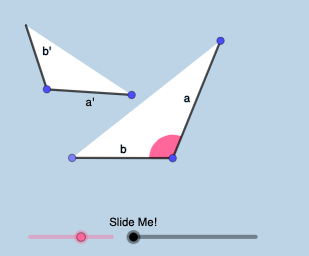
This GeoGebra example dynamically demonstrates the SAS (Side-Angle-Side) similarity theorem: if two sides of one triangle are proportional to two sides of another triangle and the included angles are equal, then the triangles are similar. Core mathematical concepts include similar triangles, proportional sides, included angles, and similarity transformations (dilation, rotation, translation). Construction highlights: basic triangles are built using Segment, Ray, Circle, and Intersect commands; corresponding sides are generated via Dilate, Rotate, and Translate; angles are measured with the Angle tool; and Polygon, CircleSector, and other objects visualize the proportional relationships. Suitable for middle and high school geometry classes, this interactive exploration helps students intuitively verify the SAS similarity condition and can be used for teacher demonstrations or student-led inquiry.
GeoGebra Commands & Parameters
Segment(A, B) → aRotate(B, (a_{2} * pi / 180), A) → B'Ray(A, B') → fPoint(f) → CSegment(A, C) → bOrthogonalLine(C, b) → rCircle(C, 1) → tIntersect(t, r, 2) → KOrthogonalLine(K, r) → i_1Point(i_1) → WRotate(E, (a_{2} * pi / 180), D) → E'Ray(D, E') → jSegment(D, E) → a'Circle(D, (a' / a * b)) → dIntersect(d, j, 1) → FSegment(D, F) → b'Line(K, b') → k_1Point(k_1) → ULine(K, a') → j_1Point(j_1) → VCircle(B, 1) → sOrthogonalLine(B, a) → qPoint(q) → MIntersect(s, q, 1) → JOrthogonalLine(J, q) → h_1Point(h_1) → PPolygon(A, B, C) → t1, c, a_1, b_{1}Polygon(D, F, E) → t2, e, d_1, f_1Min({a, a', b, b'}) → gCircle(A, (0.35 * g)) → hIntersect(h, a, 1) → GIntersect(h, b, 1) → HCircleSector(A, G, H) → kLine(A, a') → iDilate(A, If[0 < l ≤ 1, 1 - l, 0], D) → A'Vector(A, A') → uTranslate(k, u) → k'Point(i) → IAngle(I, A, B) → αRotate(k', If[0 < l ≤ 1, ((-l) * α), (-α)], A') → k''CircleArc(A, G, H) → pDilate(D, If[1 < l ≤ 2, 2 - l, 0], J) → D'Vector(D, D') → vTranslate(D, v) → D'_{1}Translate(E, v) → E'_{1}Segment(D'_{1}, E'_{1}) → a''Line(J, a') → g_1Point(g_1) → LAngle(P, J, L) → βRotate(D'_{1}, If[1 < l ≤ 2, ((l - 1) * β), β], D'_{1}) → NRotate(E'_{1}, If[1 < l ≤ 2, ((-(l - 1)) * β), (-β)], D'_{1}) → OSegment(N, O) → a'''Dilate(D, If[2 < l ≤ 3, 3 - l, 0], K) → D'_{2}Vector(D, D'_{2}) → wTranslate(D, w) → D'_{3}Translate(E, w) → E'_{2}Point(j_1) → QPoint(i_1) → RAngle(W, K, U) → γRotate(D'_{3}, If[2 < l ≤ 3, ((l - 2) * γ), γ], D'_{3}) → SRotate(E'_{2}, If[2 < l ≤ 3, ((l - 2) * γ), γ], D'_{3}) → TTranslate(D, w) → D'_{4}Translate(F, w) → F'Segment(D'_{4}, F') → b''Rotate(D'_{4}, If[2 < l ≤ 3, ((-(l - 2)) * γ), (-γ)], K) → ZRotate(F', If[2 < l ≤ 3, ((-(l - 2)) * γ), (-γ)], K) → F''Segment(Z, F'') → b'''If(o, 6, 3) → c_1Angle(A, C, B) → δIntersect(t, b, 1) → A_1Rotate(A_1, If[3 < l ≤ 4, ((l - 3) * δ), δ], C) → B_1CircleSector(C, A_1, B_1) → e_1Dilate(C, If[5 < l ≤ 6, 6 - l, 0], F) → C'Vector(C, C') → u_1Translate(e_1, u_1) → p_1Line(C, b') → l_1Point(l_1) → C_1Angle(C_1, C, A) → εRotate(p_1, If[5 < l ≤ 6, ((-(l - 5)) * ε), (-ε)], C') → q_1
AI Drawing Prompt Reference
Construct two triangles on the plane to explore the SAS similarity condition. First create a base segment and a vertex at one endpoint, then form the first triangle by defining a rotated ray and connecting the vertex to a second point. Use perpendicular helper lines and circle intersections to locate additional points so that the two sides and the included angle are well defined; draw a circle and a sector/arc to visualize the angle at the vertex. Then build a corresponding second triangle by applying transformations (rotation, dilation, and translation) to map the key sides and their included angle to the new position. Finally connect the corresponding points with polygons, keeping the matching segments and the angle sector/arc for visual verification of SAS similarity.
The prompt above was compiled from the original drawing commands and is for reference only.