
Dilation of Regular Polygons in a Ring Pattern
Loading the math board and drawing, please wait…
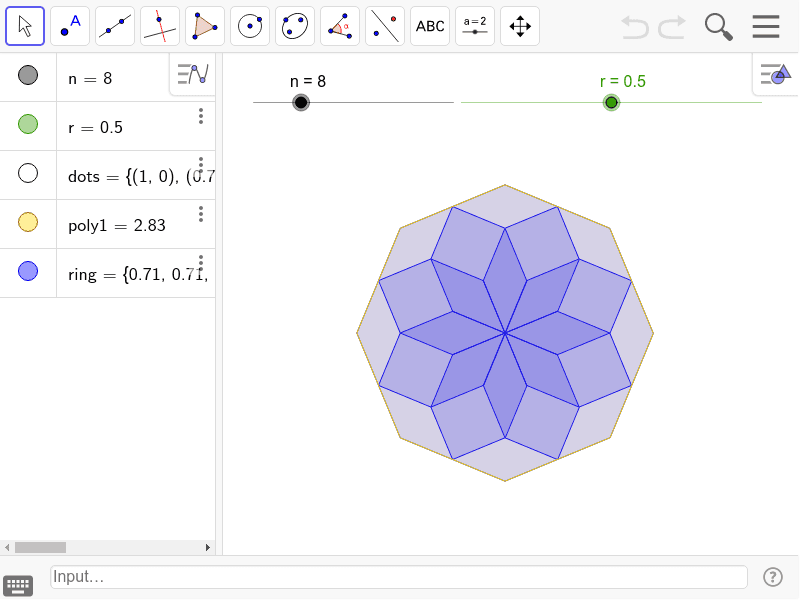
① This example demonstrates a ring of regular polygons that are dynamically dilated to create a symmetric pattern. ② Core mathematical concepts include properties of regular polygons, similarity transformations and dilation ratios, sequence‑generated discrete point sets, and the symmetry of circular arrangements. ③ Construction highlights: the Sequence command creates parameters n, r and the point list dots; the Polygon command builds the base polygon poly1; the ring object then applies dilation and replication to form the full ring. ④ Suitable for high‑school geometry, college transformation geometry courses, and as a GeoGebra teaching resource.
GeoGebra Commands & Parameters
Sequence(Rotate[(1, 0), ((2 * π) * k / n), (0, 0)], k, 0, n - 1) → dotsPolygon(dots) → poly1Sequence(Dilate[poly1, r, Element[dots, k]], k, 1, n) → ring
AI Drawing Prompt Reference
Draw a ring of regular polygons arranged symmetrically around a common center. Start by placing n points evenly on a circle, which serve as vertices of a base regular polygon. Then, for each vertex, dilate the base polygon by a fixed ratio r, using that vertex as the center of dilation. This creates n similar polygons of varying sizes, all oriented toward the center, forming a circular pattern with rotational symmetry and a dynamic scaling effect.
The prompt above was compiled from the original drawing commands and is for reference only.