
Diameters and Chords in a Circle
Loading the math board and drawing, please wait…
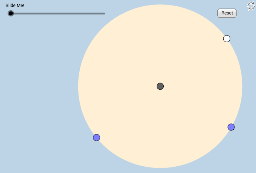
This applet helps students discover that in a circle, if a diameter is perpendicular to a chord, it bisects the chord. Key concepts include circle properties, relationships between diameters and chords. GeoGebra commands used include Circle, Intersect, Segment, OrthogonalLine, etc. Suitable for middle school and above students for geometric construction.
GeoGebra Commands & Parameters
Circle(A, B) → cIntersect(c, a, 1) → CIntersect(c, a, 2) → DCircleArc(A, C, D) → dPoint(d) → ECircleArc(A, E, D) → ePoint(e) → FSegment(E, F) → fOrthogonalLine(A, f) → gIntersect(g, f) → GCircle(G, (0.2 * Distance[A, B])) → hIntersect(h, g, 2) → HIntersect(h, g, 1) → IIntersect(h, f, 1) → JIntersect(h, f, 2) → KIntersect(c, g, 1) → LIntersect(c, g, 2) → MDilate(E, If[0 < b ≤ 1, 1 - b, 0], F) → E'Segment(E, E') → iDilate(A, If[1 < b ≤ 2, 2 - b, 0], L) → A'Dilate(A, If[1 < b ≤ 2, 2 - b, 0], M) → A'_1Segment(A, A'_1) → jSegment(A, A') → kCircleSector(G, K, H) → pCircleArc(A, L, F) → qCircleArc(A, E, L) → rSegment(G, F) → lRotate(p, If[2.5 < b ≤ 3.5, ((b - 2.5) * π / 2), 1.5708], G) → p'Segment(E, G) → mRotate(G, If[3.5 < p ≤ 4.5, ((p - 3.5) * π / 2), 1.5707963267948966], G) → G'Rotate(F, If[3.5 < p ≤ 4.5, ((p - 3.5) * π / 2), 1.5707963267948966], G) → F'Rotate(G, If[3.5 < b ≤ 4.5, ((b - 3.5) * π / 2), 1.5707963267948966], G) → G'_1Rotate(F, If[3.5 < b ≤ 4.5, ((b - 3.5) * π / 2), 1.5707963267948966], G) → F'_1Rotate(G, If[3.5 < b ≤ 4.5, ((b - 3.5) * π), 3.141592653589793], G) → G'_2Rotate(F, If[3.5 < b ≤ 4.5, ((b - 3.5) * π), 3.141592653589793], G) → F'_2Segment(G'_2, F'_2) → l'CircleArc(G, K, H) → sRotate(F, If[4.5 < b ≤ 5.5, ((-(b - 4.5)) * π / 2), -1.5707963267948966], A) → F'_3CircleArc(A, F'_3, F) → tAngle(L, A, F) → αRotate(q, If[4.5 < b ≤ 5.5, ((-(b - 4.5)) * α), (-α)], A) → q'Rotate(L, If[4.5 < b ≤ 5.5, ((-(b - 4.5)) * α), (-α)], A) → L'CircleArc(A, E, L') → c_1
AI Drawing Prompt Reference
Draw a circle with a chord. From the center, draw a perpendicular line to the chord, intersecting it at its midpoint. Place a point on the chord and connect it to the center. Construct a sector with the center as vertex and the chord as base. Add a small circle centered at the midpoint, intersecting the perpendicular and the chord. Use rotations and dilations to illustrate that a diameter perpendicular to a chord bisects it, and label the relevant angle.
The prompt above was compiled from the original drawing commands and is for reference only.