
Diagonals of a Trapezoid
Loading the math board and drawing, please wait…
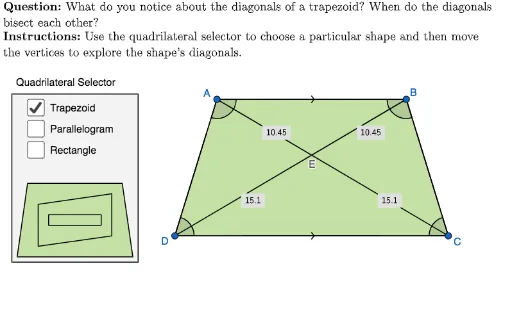
This example demonstrates the properties of the diagonals of a trapezoid. Key mathematical concepts include the definition of a trapezoid, area calculation, and the properties of its diagonals. Using GeoGebra commands such as Polygon, PointIn, Intersect, etc., a trapezoid is constructed and the intersection of its diagonals is observed. Suitable for middle and high school students learning geometric construction and related properties.
GeoGebra Commands & Parameters
Polygon({(-6, 19), (26, 19), (26, 0), (-6, 0)}) → viewBoxPointIn(viewBox) → recBPointIn(viewBox) → paraBPointIn(viewBox) → trapBPointIn(viewBox) → recAPointIn(viewBox) → paraAPointIn(viewBox) → trapAPointIn(viewBox) → trapCPoint(Ray[trapC, Vector[trapB, trapA]]) → trapDPointIn(viewBox) → paraCIf(showTrapezoid, trapB, If[showParallelogram, paraB, recB]) → BIf(showTrapezoid, trapA, If[showParallelogram, paraA, recA]) → ALine(A, B) → lineTopPoint(OrthogonalLine[recB, lineTop]) → recCIf(showTrapezoid, trapC, If[showParallelogram, paraC, recC]) → CLine(B, C) → lineRightIntersect(Line[recA, lineRight], Line[recC, lineTop]) → recDIntersect(Line[paraA, lineRight], Line[paraC, lineTop]) → paraDLaTeX((((("\text{" * QUESTION) * "\\") * INSTRUCTIONS) * "}")) → TEXTPolygon({(-19.5, 19.5), (-7.5, 19.5), (-7.5, 3.5), (-19.5, 3.5)}) → selectorBoxQuadrilateralPolygon({(-18, 11), (-9, 11), (-8, 4), (-19, 4)}) → selectorShapeTrapezoidPolygon({(-17, 9), (-10, 10), (-10, 6), (-17, 5)}) → selectorShapeParallelogramPolygon({(-16, 8), (-16, 7), (-11, 7), (-11, 8)}) → selectorShapeRectanglePolygon({Vertex[selectorShapeParallelogram]}) → selectorBorderParallelogramPolygon({Vertex[selectorShapeTrapezoid]}) → selectorBorderTrapezoidIf(showTrapezoid, trapD, If[showParallelogram, paraD, recD]) → DPolygon({Vertex[selectorShapeRectangle]}) → selectorBorderRectangleSegment(A, B) → ABSegment(A, C) → ACSegment(A, D) → ADSegment(B, C) → BCSegment(D, B) → DBSegment(D, C) → DCMidpoint(AB) → midABMidpoint(AD) → midADMidpoint(BC) → midBCMidpoint(D, C) → midDCSegment(A, Midpoint[Segment[midAB, B]]) → AB_1Segment(Midpoint[Segment[midAB, A]], B) → AB_2Segment(Midpoint[Segment[midAD, D]], A) → AD_1Segment(Midpoint[Segment[midAD, A]], D) → AD_2Segment(Midpoint[Segment[midBC, C]], B) → BC_1Segment(Midpoint[Segment[midBC, B]], C) → BC_2Segment(D, Midpoint[Segment[midDC, C]]) → DC_1Segment(Midpoint[Segment[midDC, D]], C) → DC_2Polygon({A, B, C, D}) → quadrilateralIntersect(AC, DB) → EAngle(A, B, C) → ABCAngle(B, C, D) → BCDAngle(C, D, A) → CDAAngle(D, A, B) → DABLine(A, D) → lineLeftLine(D, C) → lineBottomAreParallel(lineLeft, lineRight) → parallelLeftRightAreParallel(lineTop, lineBottom) → parallelTopBottomLaTeX(UnicodeToLetter[10003]) → cmarkLaTeX(UnicodeToLetter[10007]) → xmarkLaTeX(Distance[A, E]) → labelAELaTeX(Distance[B, E]) → labelBELaTeX(Distance[C, E]) → labelCELaTeX(Distance[D, E]) → labelDE
AI Drawing Prompt Reference
Draw a trapezoid with four vertices A, B, C, and D. First, draw a parallelogram, then randomly select four points within the parallelogram as the vertices of the trapezoid. Next, draw the two diagonals of the trapezoid and observe their intersection point E. Finally, draw the two midlines of the trapezoid, which connect the midpoints of each side.
The prompt above was compiled from the original drawing commands and is for reference only.