
Derive Area of Regular Polygons
Loading the math board and drawing, please wait…
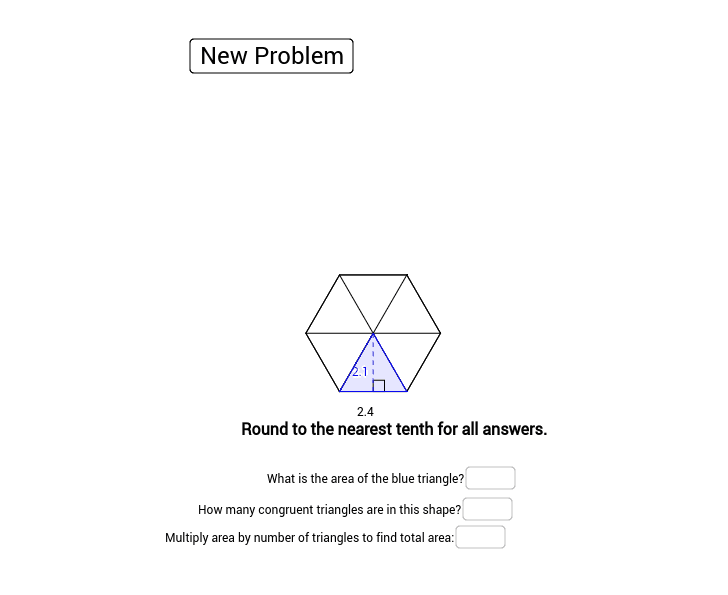
This example demonstrates how to derive the area formula for regular polygons. Key mathematical concepts include polygons, triangles, and angles. Using GeoGebra commands such as Random, Point, Midpoint, Rotate, etc., the construction of regular polygons and the derivation of their area are illustrated. Suitable for middle school and above students to learn geometric construction and area calculation.
GeoGebra Commands & Parameters
Random(3, 9) → pRandom(100, 500) → aPoint(Circle[A, b]) → BMidpoint(A, B) → IRotate(A, (-(c°)), B) → A'Line(B, A') → qRotate(B, c°, A) → B'Line(A, B') → nIntersect(n, q) → HSegment(H, I) → sSegment(A, B) → fPolygon(A, B, p) → poly1, g, C, D, E, F, G, J, K, h, i, j, k, l, m, t, dAngle(B, A, B') → αAngle(A', B, A) → βSegment(A, H) → rSequence(Segment[Rotate[A, ((360 * t / p))°, H], Rotate[H, ((360 * t / p))°, H]], t, 1, p) → list1Angle(H, I, B) → γPolygon(A, B, H) → poly2, h_1, a_1, b_1Textfield(tn) → InputBox2Textfield(ta) → InputBox1Textfield(ra) → InputBox3